
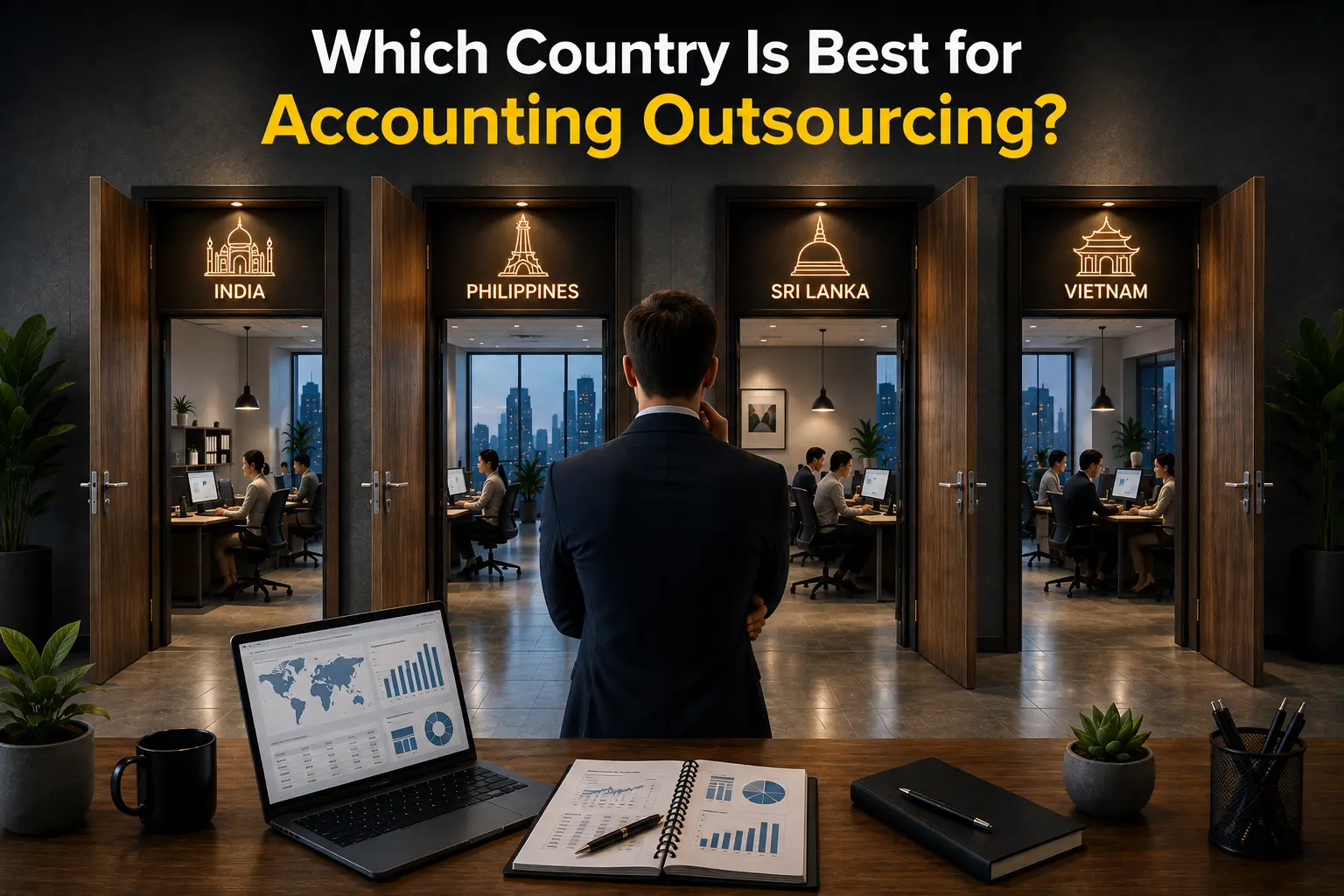
Choosing the best country to outsource accounting and finance offshore is not simply a matter of finding the lowest-cost destination. The right choice depends on the type of accounting work you need, the level of technical expertise required, communication, scalability and how well the offshore team can support your business.
For Australian businesses and accounting firms, India, the Philippines, Sri Lanka and Vietnam are among the key offshore destinations to consider. Each has different strengths: India is well suited to technical accounting and scalable finance functions, while the Philippines is particularly strong for bookkeeping and communication-focused support. Sri Lanka and Vietnam offer additional options for businesses prioritising skilled talent and cost efficiency.
The best country, therefore, depends on what you need your offshore accounting team to do, rather than a simple country ranking. This guide compares the four destinations and explains where each can fit within an Australian business’s accounting and finance function.
What Makes a Country Good for Accounting & Finance Outsourcing?
The best offshore accounting destination is not determined by cost alone. Australian businesses should consider accounting expertise, technical capability, communication, scalability and the provider’s ability to work within Australian business requirements.
Key factors include:
- Accounting expertise: Availability of qualified professionals with experience across bookkeeping, reporting, finance and other accounting functions.
- Technical capability: Ability to handle work beyond routine bookkeeping, including financial reporting, analysis and complex accounting processes.
- Communication: English proficiency and clear communication with Australian teams, clients and stakeholders.
- Cost efficiency: The overall value delivered by the offshore team, rather than simply the lowest hourly rate.
- Scalability: Whether the provider can add resources as workload and business requirements grow.
- Technology: Familiarity with cloud accounting platforms used by the business.
- Australian requirements: Experience with Australian accounting workflows, reporting practices and business expectations.
- Data security and quality control: Appropriate processes for protecting financial information and reviewing completed work.
These factors provide a more useful basis for choosing an outsourcing destination than simply ranking countries by cost. The right option depends on the type and complexity of accounting work being outsourced and how the offshore team will operate with the Australian business.
Best Countries for Offshore Accounting & Finance Outsourcing
Four destinations stand out for Australian businesses considering offshore accounting support: India, the Philippines, Sri Lanka and Vietnam. They are not interchangeable, however. Each offers different strengths depending on the type of work, required expertise and level of support a business needs.
| Country | Best suited for | Key strength |
| India | Technical accounting, finance and scalable teams | Depth of accounting and finance talent |
| Philippines | Bookkeeping, recurring accounting and client-facing support | Communication and service delivery |
| Sri Lanka | Accounting support and specialised teams | Skilled talent and value |
| Vietnam | Cost-efficient finance operations | Competitive costs and a growing talent base |
India: Best for Technical Accounting, Finance & Scale
India is one of the most established destinations for offshore accounting and finance outsourcing, with a large pool of accounting and finance professionals and experience supporting businesses across different markets.
Its biggest advantage is depth and scalability. Indian outsourcing teams can support routine bookkeeping alongside more technical functions such as financial reporting, management accounting, reconciliations, financial analysis and broader finance operations.
What is India Best Suited for?
India can be a strong fit for businesses that need:
- Complex or technical accounting support
- Financial reporting and analysis
- Bookkeeping and reconciliations at scale
- Accounts payable and accounts receivable
- Management accounting and finance support
- Dedicated or larger offshore finance teams
For Australian businesses, the ability to build a team around different accounting functions can also make India suitable when outsourcing requirements grow beyond individual bookkeeping tasks.
The main consideration is not simply access to lower-cost talent, but selecting a provider with the right accounting expertise, quality controls, Australian workflow experience and team structure for the work involved.
Philippines: Best for Bookkeeping, Communication & Client-Facing Support
The Philippines is a well-established destination for accounting outsourcing, particularly for businesses that need reliable bookkeeping, recurring accounting support and communication-heavy finance processes.
One of its strongest advantages is English communication, which can make collaboration with Australian businesses and client-facing teams more straightforward. Philippine accounting teams can support functions such as bookkeeping, accounts payable and receivable, reconciliations and other recurring finance processes.
What is the Philippines best suited for?
The Philippines can be a strong fit for businesses that need:
- High-volume bookkeeping and transaction processing
- Accounts payable and accounts receivable support
- Recurring accounting and reconciliation work
- Finance administration
- Client-facing or communication-intensive support
- Scalable teams for ongoing accounting operations
For Australian businesses, the Philippines can therefore be particularly attractive when communication and consistent day-to-day accounting support are as important as cost efficiency.
As with any offshore destination, the quality of the outsourcing provider, accounting processes and review controls should be assessed alongside the country’s overall talent pool.
Sri Lanka: Best for Accounting Support & Value
Sri Lanka is an emerging option for businesses seeking skilled accounting professionals at a competitive cost. Its smaller outsourcing market can make it relevant for businesses looking for focused accounting support rather than very large offshore operations.
Sri Lankan teams can support bookkeeping, reconciliations, financial reporting and other accounting processes, depending on the provider’s capabilities.
What is Sri Lanka best suited for?
Sri Lanka can be suitable for:
- General accounting and bookkeeping support
- Reconciliations and financial record maintenance
- Financial reporting support
- Smaller or specialised accounting teams
- Cost-conscious offshore accounting services
Its main attraction is the balance between accounting talent and cost efficiency. Businesses should still assess the provider’s scale, technical expertise and Australian accounting experience before making a decision.
Vietnam: Best for Cost-Efficient Finance Operations
Vietnam is an emerging destination for offshore finance and accounting support, particularly for businesses where cost efficiency and access to a growing talent base are important.
Its outsourcing market is less established than India or the Philippines, but suitable providers can support bookkeeping, transaction processing and other finance operations.
What is Vietnam best suited for?
Vietnam can be suitable for businesses looking for:
- Cost-efficient accounting support
- Bookkeeping and transaction processing
- Recurring finance operations
- Growing offshore finance teams
- An alternative to established outsourcing markets
Its key advantage is competitive operating costs and a developing finance talent pool. Businesses should assess English communication, accounting expertise, Australian-market experience and provider maturity before choosing Vietnam for more complex finance functions.
India vs Philippines: Which Is Better for Accounting Outsourcing?
India and the Philippines are both strong offshore accounting destinations, but their strengths are not identical. The better choice depends on the type of work, level of technical expertise and communication requirements.
| Requirement | Better fit |
| Complex accounting and finance | India |
| Technical accounting and financial analysis | India |
| Large or scalable finance teams | India |
| Bookkeeping and recurring accounting | Both |
| Client-facing communication | Philippines |
| Communication-intensive support | Philippines |
| High-volume accounting operations | Both |
India generally has an advantage where businesses need broader technical accounting capability, specialised finance support or larger teams. The Philippines can be particularly attractive where English communication, bookkeeping and client-facing service delivery are priorities.
For Australian businesses, the decision should therefore be based on the specific accounting functions being outsourced, rather than assuming one country is universally better than the other.
Which Country Is Best for Your Accounting Needs?
There is no single best offshore accounting destination for every business. The right choice depends on the type of work, level of expertise, communication requirements and scale of support you need.
| If you need… | Consider… |
| Complex accounting or technical finance | India |
| Scalable accounting and finance teams | India |
| Bookkeeping and recurring accounting support | India or Philippines |
| Client-facing and communication-heavy support | Philippines |
| Smaller or specialised accounting teams | Sri Lanka |
| Cost-efficient finance operations | Vietnam |
For Australian businesses, this approach is more useful than choosing a country based purely on its ranking or hourly rates. Match the outsourcing destination to the work first, then assess the provider’s expertise, processes and ability to meet your requirements.
Does the Country Matter More Than the Outsourcing Provider?
The country you choose affects the talent pool and operating environment, but it does not determine the quality of your outsourcing arrangement on its own. The provider delivering the service can be just as important as the destination.
Two businesses outsourcing to the same country can have very different results depending on how the provider:
- Recruits and qualifies accounting professionals
- Assigns work based on experience and technical capability
- Reviews completed accounting work
- Trains teams on client-specific processes
- Manages communication and performance
- Handles changes in workload and staffing
This is particularly important when outsourcing more than routine bookkeeping. As the work moves into financial reporting, management accounting or broader finance functions, the capability of the actual team matters more than the country label.
For Australian businesses, the practical approach is therefore to shortlist suitable countries first, then assess individual providers on their accounting expertise, delivery model, quality controls and ability to support the required work.
The country determines the available ecosystem; the right outsourcing partner determines how effectively you can use it.
Is Offshore Accounting Right for Your Business?
Offshore accounting can be practical when a business needs additional finance capacity without expanding its entire internal team. It is particularly suitable when accounting processes are repeatable, clearly defined and supported by appropriate systems.
It may be worth considering when a business:
- Needs additional bookkeeping or finance capacity
- Wants to scale accounting support as workload grows
- Finds local recruitment difficult or expensive
- Needs ongoing support across bookkeeping, AP, AR or reporting
- Wants internal finance staff to focus on higher-value work
However, offshore accounting is not automatically suitable for every business. Clear processes, appropriate oversight and the right outsourcing model remain essential, particularly for complex accounting work or sensitive financial information.
Final Verdict: What Is the Best Country to Outsource Accounting?
There is no single best country for every Australian business. India is particularly strong for technical accounting, complex finance work and scalable teams, while the Philippines is well suited to bookkeeping, communication and client-facing support. Sri Lanka offers another skilled, cost-efficient option, while Vietnam can suit businesses prioritising cost-efficient finance operations.
The best choice ultimately depends on the type of accounting work, expertise required and operating model. Country selection is the starting point; the right outsourcing provider and delivery model determine how effectively that talent can support your business.
FAQs About Offshore Accounting Countries
1. Which country is best for accounting outsourcing?
India is particularly strong for technical accounting, finance functions and scalable teams, while the Philippines is well suited to bookkeeping, communication and client-facing support.
2. Is India better than the Philippines for accounting outsourcing?
Neither is universally better. India generally suits technical and complex finance work, while the Philippines can be a stronger fit for bookkeeping and communication-focused support.
3. Which country offers the most cost-effective accounting outsourcing?
Sri Lanka and Vietnam can offer competitive costs, but businesses should assess overall value, expertise and service quality rather than choosing a destination based solely on hourly rates.
4. Is offshore accounting suitable for Australian businesses?
Yes. Offshore accounting can provide scalable bookkeeping and finance capacity when the provider has suitable expertise, processes and understanding of Australian business requirements.
5. What should I look for in an offshore accounting provider?
Assess the provider’s accounting expertise, quality controls, team structure, data security, communication processes and ability to scale with your business.
6. What is the difference between offshore accounting and accounting outsourcing?
Offshore accounting refers to accounting work being performed from another country, while accounting outsourcing means engaging an external provider to perform accounting functions rather than handling them entirely in-house.