
Sales are up, yet the bank balance is down and wages fall due on Friday. That gap between work won and cash received is where growing businesses get caught. Australian businesses can scale cash flow management and forecasting without hiring in-house by combining Australian oversight with flexible outsourced accounting support. Accounting practices, startups, payroll processing firms and small businesses can add capacity while keeping control of their finances. Flexible support can help them track cash and plan for growth without adding permanent finance costs.
Accounting Gurus provides dedicated accounting and bookkeeping resources that work within each client’s workflows, with Australian management and oversight. The business retains control of financial decisions and client relationships while its support can expand or contract with demand. The sections below explain the key cash tasks, the forecast process and how an outsourced team can support them.
Book a free 30-minute consultation with Accounting Gurus to see how outsourced cash flow support could fit your business.
Key Takeaways
- Use actual receipts and payments to understand the cash position, and update forecasts as new results arrive.
- Plan customer receipts and business payments around their expected dates.
- Include tax, super, wages and other obligations in cash planning.
- Outsourced accounting resources can add flexible capacity without in-house hiring.
- Australian oversight and control of financial decisions can remain with the business.
What Does Cash Flow Management Involve?
Cash flow management tracks and controls the money a business actually receives and pays over time. In financial management, it keeps liquidity visible so routine obligations can be met and decisions can use current cash information. Actual timing matters because cash flow management in business tracks sales receipts, operating expenses, debt repayments and asset purchases.
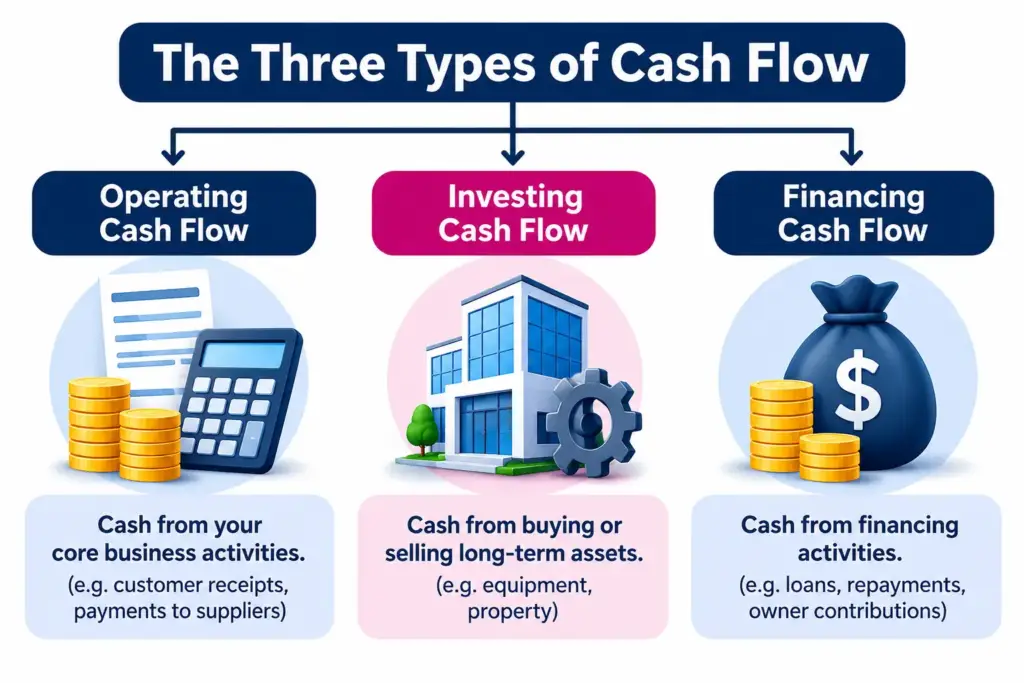
A cash flow statement groups cash movements into three types: operating, investing and financing activities. These categories show whether cash came from normal business activity, asset transactions or funding.
Cash timing versus accounting profit
Accounting profit and cash flow can differ because they record events at different times. A business may record income when it issues an invoice, before the customer pays. Cash flow reflects when that money arrives, and when the business pays its own bills.
A cash flow statement reports historical movements, while a cash flow forecast estimates future movements. Cash flow for a period is total cash inflows minus total cash outflows. Together, these views help the business understand both its past cash position and its likely future needs.
A positive profit figure alone does not show whether enough cash will be available on the day bills fall due.
The three types of cash flow
Operating cash flow comes from the business’s main activities, such as customer receipts and payments for wages or stock. Investing cash flow covers buying or selling long-term assets, such as equipment or property.
Financing cash flow includes money from loans, loan repayments and funds contributed by owners. Separating the three types helps explain what changed the bank balance and supports sound outsourced financial management.
Why Do Growing Businesses Face Cash Gaps?
A business can win more work and still face a cash gap if its costs arrive before its customer payments. The seven cash flow drivers are revenue growth, gross margin, EBITDA margins, capital expenditure, accounts receivable, accounts payable and working capital. Together, they affect the amount and timing of cash inflows and outflows.
The problem is widespread. A CommBank-commissioned survey published in January 2025 found that nearly 80% of Australian small and medium-sized businesses had experienced cash flow impacts in the previous 12 months.
Revenue growth can lift sales while also increasing the money tied up in stock, wages or work not yet paid for. Capital expenditure can tie up cash in long-term assets, including equipment, property and technology. A cash flow management example makes the timing clear: a firm records a sale today, but pays wages and suppliers before the customer settles the invoice.
Seven drivers that shift cash
Businesses can group the drivers to see where pressure may arise. A fall in margin can reduce cash left from each sale, while a rise in costs can make growth harder to fund.
- Revenue growth and gross margin affect sales cash and the amount retained from sales.
- EBITDA margins and capital expenditure affect operating cash and spending on long-term assets.
- Accounts receivable and accounts payable affect customer receipts and supplier payments.
- Working capital covers cash tied up in day-to-day business needs.
Faster sales growth may increase working-capital needs when collection lags. The business can show rising income yet struggle to pay costs that fall due first.
Warning signs in the numbers
A cash flow ratio is calculated as cash from operations divided by current liabilities. A result above 1.0 generally means operating cash covers short-term obligations. It gives a broad view only and does not replace a forecast of payment dates.
Late payment deepens the pressure. A CreditorWatch survey of more than 1,000 business decision-makers found that more than two-thirds said up to 30% of their invoices were paid late, with SMEs reporting delays of 15 to 29 days. GoCardless research found that 41% of Australian SMBs receiving late payments wait more than 14 days past the due date.
The personal cost is real too. CommBank’s 2025 research found that over a quarter of small business owners dipped into personal savings or skipped their own salary. CommBank’s Rebecca Warren has cautioned that these strategies “may not be what’s best for the business”. A forecast shows the squeeze coming before savings are needed.
How to Build a Forecast That Can Scale
A 13-week rolling forecast gives a business a full-quarter view of expected weekly cash highs and lows. A rolling forecast is a forecast refreshed regularly using actual results and updated assumptions. It helps a business plan near-term payments while keeping a view of upcoming pressure.
Short-term forecasts can cover 4 to 13 weeks, while long-term forecasts can cover 6 to 12 or more months. A cash flow forecast estimates future sales and costs, helping the business anticipate shortages, surpluses and payment capacity.
Set the forecast horizon
A short forecast suits close control of near-term cash needs. Longer forecasts support plans for commitments that sit beyond the next quarter. The right horizon should fit the timing of the business’s receipts, costs and decisions.
| Forecast horizon | Coverage | What it helps reveal |
| Short-term | 4-13 weeks | Near-term shortages and payment capacity |
| 13-week rolling | A full quarter | Weekly cash highs and lows |
| Long-term | 6-12+ months | Longer-range cash commitments and planning |
Build and refresh the numbers
Start with historical figures from accounting records and bank activity, then estimate receipts and payments by date. Enter customer inflows when payment is expected, not when the sale is recorded. Enter costs when payment is due, rather than when an order is placed.
State whether the forecast includes or excludes GST, and label estimated costs so readers can tell them from known amounts. The Australian Government’s cash flow statement template can support a current or forecast statement. Compare projected balances with actual results, then update the figures and assumptions.
A projected closing cash balance is the opening cash balance plus expected inflows minus expected outflows. A monthly closing balance uses the same calculation for that month.
How Can Businesses Improve Payment Timing?
Delayed customer receipts can keep a profitable business short of cash for its own bills. Debtor days means the average time taken to collect customer invoices. The longer the debtor days, the longer the business funds its customers’ purchases from its own cash.
Clear processes can help bring cash in sooner without putting customer or supplier ties under strain.
Bring customer payments in sooner
Send accurate invoices promptly and state the due date and payment terms clearly. Terms can call for payment upfront or within 30 days. Offer convenient ways to pay, and consider early-payment incentives when margins allow.
A consistent follow-up routine helps keep overdue accounts visible. Send reminders before the due date and on the due date, then follow up at 7 and 14 days overdue. A sound credit policy can also set limits and steps for new accounts.
Schedule supplier and stock outflows
Pay suppliers on agreed terms rather than paying unnecessarily early. Discuss payment terms where cash timing is tight; a 60-day supplier term instead of 30 days can allow the business to hold cash longer. Early-payment discounts may suit some bills when the saving outweighs the value of keeping cash.
Stocktakes and sales trends can help a business avoid holding more inventory than it needs. The right stock level matters because excess stock ties up funds that could meet other costs.
| Area | Practical lever | Cash timing effect |
| Customer invoices | Prompt invoicing and overdue follow-up | Faster receipts |
| Supplier bills | Agreed terms and planned payment dates | Better-timed outflows |
| Stock | Regular stocktakes and sales-trend-based reordering | Less cash tied up in excess stock |
Agreed supplier terms preserve cash without paying late or damaging supplier relationships.
How Does Outsourcing Add Capacity Without Hiring?
Outsourcing can add dedicated accounting capacity while the Australian business retains oversight and control of its financial decisions. Accounting Gurus provides integrated support, with dedicated offshore accounting resources working to the client’s requirements under Australian management.
This approach differs from simply hiring extra employees. The resources work within the client’s workflows, with Australian engagement oversight, workflow coordination, quality review and communication guiding delivery.
Australian oversight with offshore delivery
Accounting Gurus can draw on dedicated resources in India and the Philippines, based on service requirements. The Australian team coordinates work, reviews quality and keeps communication clear. The client defines its needs and retains control of its financial decisions.
Accounting outsourcing services in Australia can add capacity for recurring tasks without shifting business authority to an outside provider. An outsourced finance team supports the client’s processes rather than taking over its ownership or client relationships.
Flexible capacity and software fit
Flexible engagement options include block hours, part-time and full-time support. A business can match the arrangement to its current workload and adjust it as demand changes.
Accounting Gurus can support Xero, MYOB, QuickBooks, Sage and Reckon, subject to client requirements. This can help teams work within their existing systems instead of changing tools just to add capacity. Cash flow forecasting services in Australia can also fit into the wider accounting workflow.
What Work Can an Outsourced Finance Team Handle?
The right outsourced workload depends on whether the business needs client-service capacity, startup reporting, payroll reconciliation or routine SME cash visibility. Accounting support can cover bookkeeping, data preparation, reconciliations, financial reporting, cash flow tracking and forecast-related tasks.
The work should fit the firm’s or business’s own process. It can help teams keep information current and prepare reports without handing over independent financial decisions.
- CPA and accounting firms can add client forecasting and reporting capacity as their portfolios grow. Financial forecasting for accounting firms can be prepared within the firm’s review process.
- Startups can access reporting and forecast preparation without building an internal finance department.
- Payroll processing firms can add capacity for reconciliations and payment-related reporting.
- SMEs can improve cash visibility through regular tracking and routine forecast preparation.
For an accounting practice, outsourced financial management support can help prepare client data and reports as workloads rise. The firm can review the work and retain its direct role with each client. Startups can use the same kind of support to keep records and reporting tasks moving as operations develop.
Payroll teams may need extra reconciliation capacity during busy periods. SMEs can use cash flow forecasting for SMEs to prepare and maintain forecasts from current financial information. In each case, outsourced support works from agreed instructions and data access.
The service supports financial data preparation, tracking and reporting. Financial decisions, approvals and client relationships stay with the business and its authorised client-facing team.
What Should a Scalable Cash Flow Workflow Include?
A weekly cash check can surface an upcoming pressure point while there is still time to respond. It can review the bank balance, recent movements and large bills due in coming weeks. Digital accounting tools can display cash information and compile reports for review.
A repeatable workflow keeps figures useful as the amount of bookkeeping and reporting grows. Reconciliations help confirm that the records match account activity before the team relies on them.
Regular reviews and reconciliations
A weekly review can check recent receipts and payments against the bank balance, then flag upcoming bills. Larger or multi-site businesses can use monthly management reports by business unit or site. Those views help managers see where cash activity differs across operations.
Reconcile bank and accounting records on a regular schedule so reporting starts from checked figures. Assign clear responsibility for preparing, reviewing and resolving differences. That makes the same information easier to follow when workloads are shared.
Reports that show forecast variance
Compare estimated income and costs with actual results. Record each material difference and review whether it came from timing, a changed cost or an altered business trend. Then update forecasts, budgets or spending plans to reflect current information.
CommBank and UNSW’s AGSM offer a free cash flow management course for Australian small businesses. It can teach the core ideas, but recurring forecast and reporting work depends on current financial information and a repeatable process. Teams can use tools to compile reports, while people still need to check the figures and explain important changes.
How Should Businesses Plan for Obligations and Financial Risk?
Tax, super, wages and supplier bills should appear in the forecast in the period they must be paid. Rent, BAS or IAS payments and loan repayments also affect the cash a business can use. Due dates matter because a forecast must show when funds need to be available.
From 1 July 2026, Payday Super requires super contributions to reach employees’ funds within 7 business days of each payday, subject to exceptions such as new employees.
Monthly BAS or IAS is generally due on the 21st of the following month. The December 2026 monthly statement is due on 21 January 2027, or 21 February 2027 for eligible clients with turnover up to $10 million who report GST monthly and lodge electronically through a registered agent. As 21 February 2027 is a Sunday, the effective date is Monday 22 February 2027.
Put tax and payroll dates into the forecast
Quarterly BAS or IAS dates and eligible agent dates differ by reporting period. Agent dates are concessions, not entitlements; eligibility depends on the taxpayer’s circumstances, lodgement history and compliance record.
| Quarter | Standard due date | Eligible agent date |
| July-September 2026 | 28 October 2026 | 25 November 2026 for eligible electronic lodgement and payment |
| October-December 2026 | 28 February 2027 (a Sunday, so effective 1 March 2027) | No concession |
| January-March 2027 | 28 April 2027 | 26 May 2027 for eligible electronic lodgement and payment |
| April-June 2027 | 28 July 2027 | 25 August 2027, to be confirmed by the ATO |
For a small entity, the failure-to-lodge penalty is one penalty unit for each 28-day period or part period, capped at five units. From 1 July 2026, a penalty unit is $364, so the maximum is $1,820.
The general interest charge for the October to December 2026 quarter is 11.51% per annum, compounded daily, and is not deductible.
Respond early to financial difficulty
ASIC Regulatory Guide 217 sets four expectations for directors: actively monitor solvency, investigate financial difficulties, obtain suitable professional advice when needed and act in a timely way. ASIC identifies these common warning signs for small business directors:
- Increasing cash flow pressure.
- Overdue tax or superannuation payments.
- Unpaid suppliers.
- Reliance on personal funds.
Continuing to incur debts when there is no realistic prospect the company can repay them can expose directors to personal legal and financial risk. Treat rising cash pressure, unpaid obligations or reliance on personal funds as a prompt for timely professional advice and action.
How to Put a Scalable Model Into Practice
A scalable arrangement starts by defining the recurring workload and the reporting standard the business needs. The client business sets its priorities, financial requirements and reporting expectations before support begins.
For example, an accounting practice adding client forecasting and reporting work should first agree which tasks need preparation, what reports are required and who reviews them. A clear scope helps the practice add capacity without losing control of its client service.
Set priorities and reporting expectations
The business can identify the recurring work, its expected timing and the checks each task needs. Accounting Gurus provides Australian management, engagement oversight, workflow coordination, quality review and communication. Dedicated offshore resources in India and the Philippines support delivery according to service requirements.
Use a simple sequence to set up the work:
- Define priorities and reporting expectations.
- Identify recurring bookkeeping, reconciliation, tracking and forecast tasks.
- Agree a workflow and quality-review process under Australian oversight.
- Adjust support capacity as workload changes.
Expand capacity against measured workload
The workflow should name who supplies records, prepares data, reviews reports and approves payments. That clarity helps the team manage routine work while the business keeps authority over financial choices.
Measure the workload against agreed tasks and reporting dates. If volumes rise, the business can review the scope and support level rather than recruit before it understands the need.
Key Points
- Cash flow is the timing of money in and out, so a profitable business can still run short on the day bills fall due.
- A 13-week rolling forecast, refreshed with actual results, gives the clearest near-term view of cash highs and lows.
- Faster collection and agreed supplier terms improve cash timing without straining relationships.
- BAS, IAS, Payday Super and wage dates belong in the forecast in the period they are payable.
- Outsourced accounting capacity can scale with workload while the business keeps decisions, approvals and client relationships.
Conclusion
Flexible outsourced accounting support can help a business expand financial operations while keeping oversight and decisions in Australian hands. Accounting Gurus is an Australian-managed outsourcing partner that can add dedicated capacity for cash reporting, forecasting and wider finance work.
Businesses can keep control of financial decisions and client relationships while adding support to fit their workload. A free 30-minute consultation can help identify the tasks and reporting needs that may suit an outsourced arrangement.
Book a free 30-minute consultation with Accounting Gurus to discuss your cash flow reporting, forecasting and wider financial operations.
FAQ
What are the 5 cash management tools?
Five practical cash management tools are a cash flow forecast, a cash flow statement, accounting software, bank reconciliations and accounts receivable and payable tracking. The forecast estimates future receipts and payments, while the statement records past movements. Accounting software can bring records together, and reconciliations check bank activity. Tracking amounts owed by customers and to suppliers helps teams follow payment timing.
What is the best way to manage cash flow?
The best way to manage cash flow is to forecast expected receipts and payments regularly, then compare them with actual results. The business can follow up overdue invoices and plan outflows against their due dates. A weekly review may suit a business with changing receipts or costs. Regular updates help teams spot a likely cash gap while they can still adjust plans.
How often should a business update its cash flow forecast?
A business can update a short-term rolling forecast weekly, especially when receipts, costs or conditions change quickly. The review should compare actual results with expected figures and update assumptions. A slower-moving business may use a different cadence, while a fast-changing workload may need more frequent checks. The forecast remains useful when its information reflects current activity.
How far ahead should a cash flow forecast look?
A short-term cash flow forecast can cover 4 to 13 weeks, while a long-term forecast can cover 6 to 12 or more months. A 13-week view spans a full quarter and can reveal weekly cash highs and lows. The business’s volatility and planning needs shape the horizon. A near-term view supports payment planning, while a longer one helps track future commitments.
When should a business consider outsourced accounting support?
A business should consider outsourced accounting support when forecasting, reporting, bookkeeping or reconciliation work grows faster than internal capacity. This can help keep routine tasks moving without hiring an in-house team. The business should first define the work, reporting needs and review process. It can then match support to the workload while retaining financial decisions and approvals.
Disclaimer
This article provides general information about cash flow management, forecasting and Australian tax and super obligations. It does not constitute accounting, taxation, legal, financial or professional advice. Due dates, rates and eligibility depend on individual circumstances and can change. Businesses should check current requirements with the ATO or ASIC and seek advice from a qualified professional before making financial or compliance decisions.