

An EOR can put an offshore accountant on the payroll. It cannot make that accountant productive inside your practice.
For Australian accounting firms, those are two separate problems.
One is employment: how do you employ someone overseas without establishing your own legal entity in that country?
The other is delivery: how does that accountant learn your systems, follow your workpapers, meet review standards, protect client information and become dependable capacity inside the firm?
An Employer of Record can solve much of the first problem. The second still needs an accounting operating model.
What Is an Employer of Record(EOR)?
An Employer of Record (EOR) is a third-party organisation that legally employs a worker in a country where the client business may not have its own employing entity.
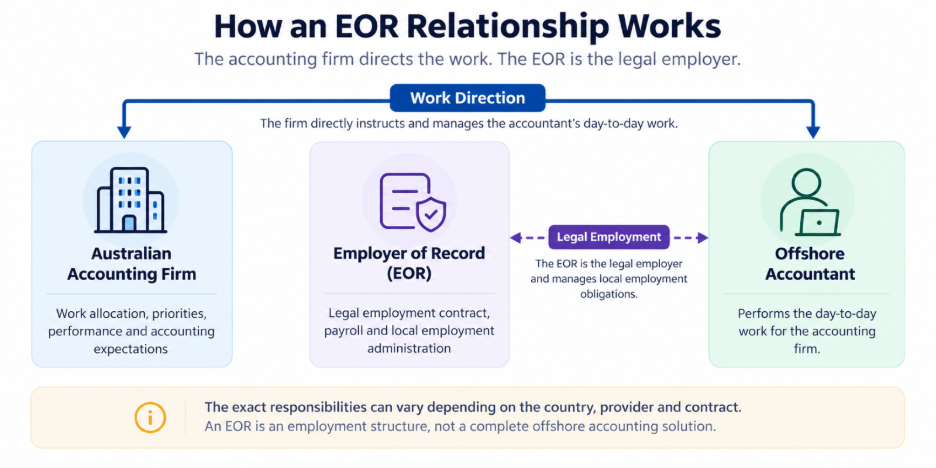
The EOR typically holds the local employment contract, runs payroll, administers employment benefits and manages relevant local tax and employment obligations. The client business continues to direct the employee’s day-to-day work.
For an Australian accounting firm hiring an accountant overseas, the relationship broadly looks like this:
| Party | Primary Responsibility |
| Australian accounting firm | Work allocation, priorities, performance and accounting expectations |
| Employer of Record | Local employment contract, payroll and employment administration |
| Offshore accountant | Performs the day-to-day work for the accounting firm |
The exact responsibilities depend on the jurisdiction, provider and contract. An EOR is an employment structure, not a blanket exemption from every cross-border obligation.
How an EOR Relationship Works
What Does an EOR Actually Solve?
The model is attractive when an Australian firm wants an ongoing employee overseas but does not want to establish and maintain its own employing entity purely to make that hire.
Depending on the country and agreement, the EOR can take care of the local employment contract, payroll, statutory withholding and contributions, employment benefits and local employment administration.
That can remove substantial HR and legal infrastructure from the firm’s workload.
But it solves a very specific problem:
How do we employ this person?
It does not automatically answer:
How do we make this person effective inside an Australian accounting practice?
That second question is where a standard EOR arrangement can fall short.
What Still Sits With the Accounting Firm?
A pure EOR normally does not take ownership of your accounting delivery model.
The firm may still need to decide whether the accountant has the right Australian accounting capability, how they will be onboarded into practice systems, who allocates and reviews work, how technical gaps are handled, how performance is managed and what happens when the resource is unavailable.
Data access and professional responsibilities also remain relevant.
For registered tax practitioners, moving work offshore does not remove the need to provide competent services or maintain adequate supervision and control. The TPB specifically says practitioners need to consider competency, supervision and client confidentiality when outsourcing or offshoring tax services.
So an EOR can create a valid employment structure without creating a complete offshore accounting capability.
Why Not Just Call the Accountant a Contractor?
Because the contract label does not necessarily determine the legal relationship.
From 26 August 2024, constitutionally covered Australian businesses generally use the Fair Work whole of relationship test for work performed from that date. It considers the real substance, practical reality and true nature of the relationship, including how the arrangement actually operates. Relevant factors can include control, financial risk, equipment, delegation, working hours and whether ongoing work is expected.
An ABN, invoice or contract describing someone as an independent contractor does not automatically make them one.
A useful offshore example is Doessel Group Pty Ltd v Joanna Pascua.
Ms Pascua worked from the Philippines as a legal assistant and had been treated as an independent contractor. The Fair Work Commission found she was an employee, and the Full Bench refused permission to appeal that finding in February 2025.
The case requires one important qualification: the relevant work pre-dated the 26 August 2024 reforms, so the current whole-of-relationship test was not the test applied to that engagement.
Its relevance is narrower but important:
an offshore location and a contractor label do not, by themselves, settle the employment question.
Does an EOR Remove Cross-Border Risk?
No.
An EOR can help manage local employment obligations, but Australian firms should be cautious of any suggestion that it makes every international legal or tax question disappear.
Pitcher Partners notes that EOR arrangements can create tax and legal considerations as they develop, including potential permanent establishment exposure depending on factors such as the number of employees in a jurisdiction and the activities or responsibilities they undertake.
The ATO likewise recognises that permanent-establishment questions can involve a fixed place of business or, in relevant circumstances, a dependent agent with authority to enter contracts. The actual outcome depends on the facts and applicable international tax rules.
Client data adds another consideration. Where the Australian Privacy Principles apply and personal information is disclosed to an overseas recipient, APP 8 and section 16C can affect the Australian entity’s obligations and accountability.
These issues do not make EOR unattractive. They mean the structure still needs to be assessed properly.
EOR, Outsourcing or Your Own Offshore Entity?
The answer depends on what problem the firm actually wants to solve.
| Model | Primary Purpose | Accounting Firm’s Operational Involvement |
| EOR | Employ a person overseas without your own local entity | High |
| Accounting outsourcing | Obtain accounting delivery capacity | Lower, under an agreed workflow |
| Own overseas entity | Build and control your own offshore operation | Very high |
| Hybrid operating model | Combine dedicated people with employment and accounting-delivery infrastructure | Shared |
Here, hybrid operating model is a commercial framework, not a separate legal employment category. The underlying legal employment arrangement still needs to be properly structured.
An EOR is therefore not better or worse than outsourcing.
They solve different problems.
When Does an EOR Make Sense for an Accounting Firm?
An EOR is particularly relevant when the firm has already decided it wants a specific person or role overseas, wants to direct that person’s work itself, does not have an employing entity in that country and is prepared to own the accounting workflow around the employee.
If the firm’s real problem is instead:
“We have more tax, bookkeeping, SMSF or accounting work than our existing team can complete efficiently”
then establishing an employment relationship may only solve part of the capacity issue.
The firm still needs the resource selection, onboarding, accounting processes, supervision, review structure, security and continuity that turn a person into functioning practice capacity.
Why an EOR Alone May Not Build Offshore Accounting Capacity
Imagine two firms hiring comparable offshore accountants.
Firm A uses an EOR to handle the employment structure. The accountant is hired and payroll is running. The firm then builds the role around them: systems access, training, workflow allocation, performance expectations, quality review and backup arrangements.
Firm B combines its dedicated resource with an established accounting delivery environment. Employment is properly structured, but the resource also enters a defined onboarding, workflow, supervision and quality framework.
Both have solved the hiring problem.
Firm B has also solved more of the delivery problem.
For an accounting practice, that difference matters because the real return does not come from successfully employing someone overseas. It comes from what that person can consistently deliver after joining the workflow.
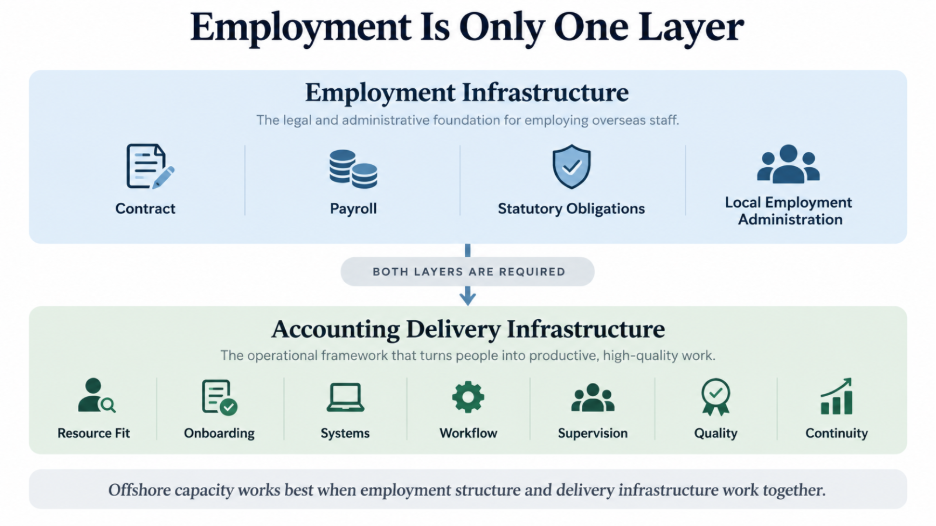
Employment Is Only One Layer
Where Accounting Gurus Adds the Delivery Layer
Accounting Gurus is designed around the operational side of offshore accounting capacity.
Its six-stage onboarding process starts by defining scope, responsibilities and workflows before delivery begins. The offshore resource is then selected for relevant skills and software experience, trained on the client’s systems and processes, and tested across agreed workflows before live delivery. AGs also documents Australian-led quality checks, delivery supervision and backup-resource coverage as part of the model.
For firms that need consistent day-to-day capacity, AGs offers the same dedicated accountant working within agreed systems and processes. Where a full-time resource is unnecessary, the model can instead provide recurring monthly capacity or pay-as-you-go support.
This is where the commercial distinction becomes useful.
An EOR can solve the employment infrastructure.
A structured offshore accounting model addresses the delivery infrastructure around the accountant.
For firms considering both, the stronger question is not whether EOR and outsourcing compete. It is which elements of each are needed to create the operating model the practice actually wants.
Employ the Person. Build the Capability.
An Employer of Record can remove a major obstacle to international hiring: establishing the legal employment infrastructure around an offshore employee.
But the employment contract is only the beginning.
Australian accounting firms still need to decide who will select the right accountant, train them on practice systems, manage workflows, supervise work, maintain quality and provide continuity when circumstances change.
If employment is the only problem, an EOR may be enough.
If the real objective is reliable offshore accounting capacity, the operating environment around the resource matters just as much.
Accounting Gurus helps Australian accounting firms build that capacity through dedicated offshore accounting resources, structured onboarding, client-specific workflows and Australian-led delivery oversight.
Don’t stop at asking how to employ an accountant overseas. Ask what will make that accountant work successfully inside your practice.