

Australian accounting firms are still struggling to find experienced talent. In CA ANZ’s 2026 shortage survey, the lack of experienced professionals was the main reason accounting and finance vacancies went unfilled.
That is pushing more firms to widen their search offshore, particularly into the Philippines and India.
The opportunity is significant but only if the hire is right. Firms need to know what role they are filling, what Australian accounting capability to test, and which market best fits the work.
Hire well, and offshore talent can become a reliable capacity inside the practice rather than another recruitment experiment.
Why India and the Philippines Are Established Offshore Talent Markets
India and the Philippines are not new entrants to offshore professional services. Both have large, established workforces supporting international businesses across finance, accounting and business-process functions.
The Philippines: A Mature Global Services Workforce
The Philippines’ IT-BPM industry now employs about 1.9 million people and generates around US$40 billion in revenue. Finance and accounting is an established part of that services ecosystem.
Its accounting pipeline also continues to produce qualified professionals. In the May 2026 CPA licensure examination, 3,004 candidates qualified, following another 3,460 successful candidates in October 2025.
That established outsourcing environment is one reason the Philippines is already familiar territory for many Australian accounting firms.
India: Scale Backed by a Deep Accounting Profession
India brings a different kind of scale. Its BPM industry reached almost US$49 billion in FY2024, with finance and accounting among the functions operating within the sector.
The professional accounting base is also substantial. The Institute of Chartered Accountants of India reports more than 4 lakh members and around 9.85 lakh students, making ICAI the world’s largest professional accountancy body.
For Australian firms, that creates access to a broad pool spanning bookkeeping, accounting, tax, audit and finance experience.
The opportunity in either market is not simply access to more people. It is access to a larger talent pool from which the right person can be hired for the work your firm actually needs.
Where Should an Offshore Accountant Fit in Your Team?
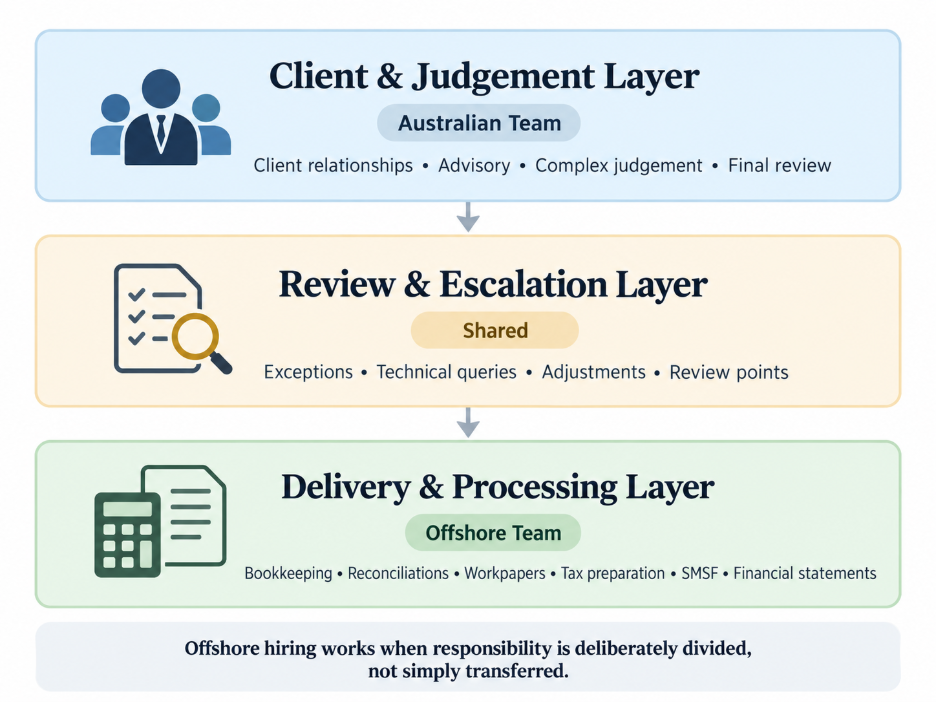
Hiring offshore works best when the role is designed around work ownership, not simply around moving tasks overseas.
Some work should stay close to partners and senior staff in Australia. Other work can be owned by an experienced offshore accountant. A third group sits naturally between both teams, where review, judgement or escalation is required.
| Work Layer | Typical Responsibilities |
| Australian Team | Client relationships, advisory, complex judgement, final review and partner-level decisions |
| Shared | Exceptions, complex adjustments, technical queries, review points and escalation |
| Offshore Accountant | Bookkeeping, reconciliations, workpaper preparation, tax preparation, SMSF processing, financial statement preparation and recurring compliance work, depending on capability and supervision |
The objective is not to offshore everything possible. It is to move the right work to the right level so Australian staff spend less time on repeatable delivery and more time where their experience creates greater value.
A senior offshore accountant may be capable of owning substantially more than a junior processor. That is why the position description should define what the person can prepare, what they can complete independently, and what must come back to the Australian team for review or judgement.
Done well, the offshore role becomes part of the firm’s workflow rather than a separate task queue sitting outside it.
Related Reading
Before You Hire an Offshore Accountant: Check These Four Things
Once you know where the role fits, the next decision is how the person will actually be hired and work inside your firm.
| Check | What Australian Firms Should Confirm |
| Employment Structure | Will the person be employed locally, engaged through an EOR, hired through a provider or genuinely operate as an independent contractor? The contract label alone does not determine employment status. |
| True Cost | Compare more than salary. Allow for statutory employment costs, provider or EOR fees, equipment, software, onboarding, training and the review time required from your Australian team. |
| Data & Client Confidentiality | Confirm where client information will be accessed, what systems the accountant can use, how access is controlled and what happens when employment ends. TPB and Australian privacy obligations may remain relevant when work is performed offshore. |
| Proven Capability | Verify the work the candidate has personally completed. Australian experience, software familiarity and qualifications should be demonstrated through role-specific questions and practical testing—not assumed from a CV. |
Employment Structure Deserves Particular Attention
For permanent offshore roles, many firms use a local employing entity, an Employer of Record (EOR) or an offshore accounting provider rather than trying to employ someone directly in a country where they have no entity.
If an independent-contractor model is being considered, the actual working relationship matters. Australian Fair Work guidance makes clear that simply calling someone a contractor does not necessarily make them one.
Related reading: Employer of Record for Australian Accounting Firms: What EOR Solves and What It Doesn’t
Do Not Compare Salary Alone
A lower headline salary can still become an expensive hire if the accountant requires heavy retraining, produces repeated review points or cannot independently handle the work they were hired to own.
The useful comparison is:
Total employment cost + operating cost + Australian review time = real cost of the hire.
That applies whether the accountant is based in India or the Philippines.
Security Should Be Checked Before Access Is Granted
For registered tax practitioners, offshoring does not remove responsibilities around competent service delivery, supervision and client confidentiality.
Where Australian privacy law applies, overseas handling of personal information can also raise cross-border privacy considerations.
Related reading:
Offshore Bookkeeping Data Security: What Australian Firms Should Check Before Outsourcing
Make the Offshore Hire Work After Day One
Hiring the right accountant is only the start. The value comes from how quickly they understand your standards, take ownership of work and reduce pressure on the Australian team.
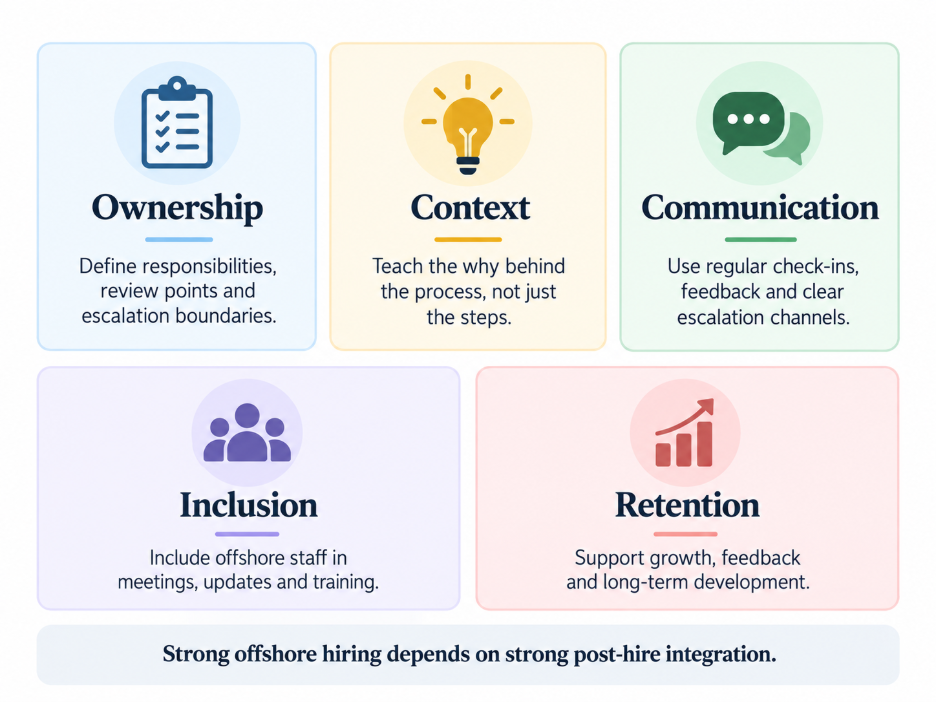
Clear development paths, meaningful responsibility, regular feedback and appropriate remuneration reviews matter whether the person sits in India, the Philippines or Australia.
The strongest offshore hire is not the person who stays busy. It is the person who progressively needs less explanation while taking more useful work off the Australian team’s desk.
What Accounting Talent Can Australian Firms Access in India and the Philippines?
Both India and the Philippines have established accounting and business-services talent pools, but Australian firms should look beyond country stereotypes when hiring.
India offers significant depth across accounting, bookkeeping, tax, SMSF, audit support and broader finance roles. ICAI alone represents a professional accounting ecosystem of more than a million members and students, giving firms access to a substantial pool of accounting-trained talent.
The Philippines has a mature offshore-services sector and a long history of supporting international accounting and finance teams. Its accounting workforce includes CPAs, accounting graduates and professionals experienced in bookkeeping, financial reporting and shared-services environments.
For Australian firms, the practical question is not which country is universally better.
It is:
Which market gives you access to the right person for the role you actually need to fill?
Australian experience, technical capability, software knowledge and communication still need to be tested at candidate level.
That is all this country section needs to do.
How Accounting Gurus Helps Firms Hire the Right Offshore Talent
Finding candidates offshore is not difficult. Finding someone with the right accounting experience, software capability and fit for an Australian practice is where the work begins.
Accounting Gurus gives Australian firms access to an established offshore talent base rather than requiring them to build that search from scratch.
AGs has a strong accounting workforce talent in India and the Philippines, supporting bookkeeping, accounting, tax, SMSF and related finance work, allowing the resource market to be matched to the work required.
Resources are selected against the firm’s role, experience and software requirements, then onboarded into the client’s systems and processes before regular delivery begins.
The advantage is straightforward:
You still decide what your firm needs. AGs helps you find and establish the offshore resource capable of doing it.
Hire the Right Accountant
India and the Philippines both open up strong talent markets for Australian accounting firms. What matters is whether the person can meet your standards, own the work and strengthen the capacity of your existing team.
Accounting Gurus helps firms access that talent, assess the right fit and bring the resource into the practice with the right support around them.
Don’t hire someone because they are offshore. Hire the accountant you would want on your team, wherever they happen to be.