
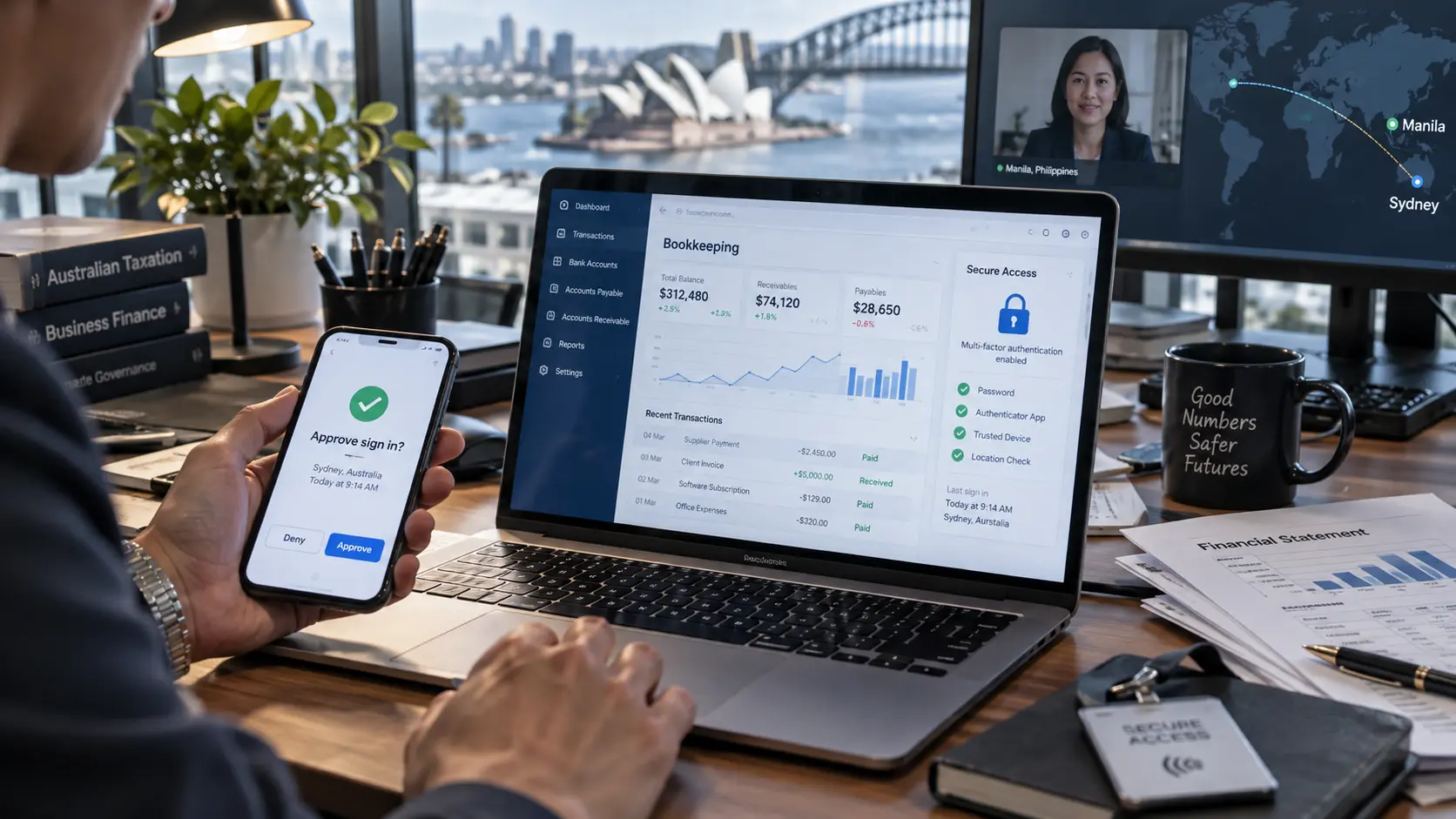
The biggest security risk in offshore bookkeeping is not offshore. It is uncontrolled access.
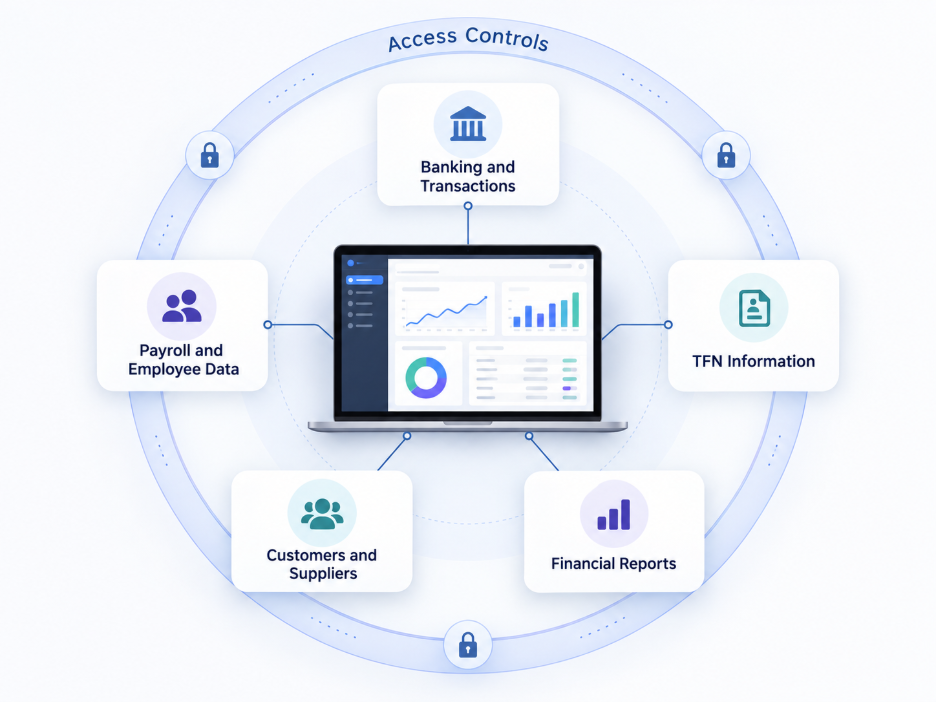
An offshore bookkeeper may need access to bank transactions, payroll records, invoices, employee information, customer and supplier data and, depending on the work, TFN information.
The real security questions are therefore: who can access the data, what can they do with it, where can they access it from, and what prevents it leaving the approved environment?
For Australian accounting firms, privacy and professional obligations can also remain with the Australian practice even when part of the work is performed overseas.
What Data Does an Offshore Bookkeeper Actually Access?
A bookkeeper does not automatically need access to every record in a client’s file. Access should reflect the work they are responsible for.
| Data Category | Examples | Why It Matters |
| Financial records | Bank transactions, invoices, receipts, account balances | Reveals financial position, spending and payment information |
| Payroll data | Wages, employee bank details, superannuation information | Contains personal and financial information |
| TFN information | TFNs where genuinely required for the work | Subject to separate TFN handling requirements |
| Client and supplier data | Names, contact details, invoices, payment histories | May contain personal and commercially sensitive information |
| Internal business information | Margins, expenses, cash flow and financial reports | Can expose commercially valuable information |
The first security question is not:
“Is the bookkeeper offshore?”
It is:
“Does this person have access to more information than their role requires?”
This matters particularly for TFNs. OAIC guidance requires TFN recipients to restrict access to staff who need the information for an authorised purpose.
What Sits Inside a Bookkeeping File
What Actually Changes When Bookkeeping Goes Offshore?
Australian privacy law is more nuanced than assuming overseas access automatically means information has legally been “sent overseas”.
Where the Privacy Act applies, APP 8 generally requires an APP entity to take reasonable steps before disclosing personal information to an overseas recipient to ensure the recipient does not breach the relevant Australian Privacy Principles. In some circumstances, the Australian entity may also remain accountable for the overseas recipient’s conduct under section 16C.
OAIC guidance also recognises limited circumstances where providing information to an overseas contractor may constitute a use rather than a disclosure if the Australian entity retains effective control over how the information is handled.
Relevant factors can include:
- contractual restrictions
- controls over subcontractors
- access permissions
- security measures
- the ability to retrieve, change or delete information
- what happens to the information when the arrangement ends
Whether an offshore resource logs into Xero or another cloud platform does not, by itself, determine the APP 8 position. The actual contractual and operational arrangement matters.
Where Offshore Bookkeeping Security Actually Breaks Down
Security problems usually begin with weak controls, not geography.
Risk increases when an arrangement relies on:
- shared user credentials
- access broader than the work requires
- unmanaged personal devices
- local downloads of client files
- uncontrolled removable storage
- personal email for financial information
- weak or missing activity logs
- access remaining active after someone leaves an engagement
- undisclosed subcontractors
- no defined incident-response process
APP 11 takes a similarly broad view of security. For entities covered by the Privacy Act, reasonable steps can involve governance, ICT security, access controls, third-party providers, physical security, data-breach preparedness and secure destruction or de-identification.
Encryption matters, but it does not answer the entire security question.
A firm also needs to know who can access the information after they have successfully logged in and what they can do with it.
What Does a Secure Offshore Bookkeeping Setup Look Like?
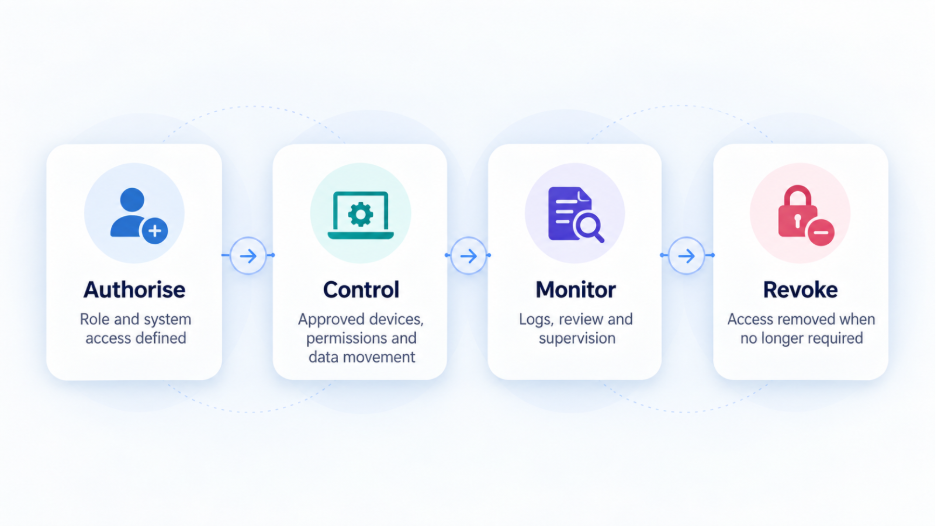
A stronger model controls access throughout the engagement.
Before Access Is Granted
Define:
- which systems are required
- which clients or entities the resource needs
- which functions the role requires
- whether TFN access is necessary
- whether information can be downloaded or only accessed within approved systems
Access should follow the work, not convenience.
While the Work Is Being Performed
Look for layered controls.
Individual credentials
Each user should be identifiable rather than working through shared accounts.
Least-necessary access
A resource handling reconciliations should not automatically receive administrator-level permissions.
Controlled devices and work environments
Security should cover workstations, removable storage, personal devices and physical access.
Auditability
Access and material changes should be traceable.
Restricted data movement
The ability to copy, email, download or transfer information should be controlled according to the work being performed.
When Access Changes or Ends
Permissions should be reviewed or removed when:
- a resource changes roles
- the scope of work changes
- a client leaves
- a staff member leaves the provider
- the outsourcing arrangement ends
Strong onboarding without disciplined offboarding still leaves unnecessary access behind.
The Offshore Access Lifecycle
What Do Australian Tax Practitioners Need to Consider?
For registered tax practitioners, offshore data access can also engage TPB obligations.
The Code of Professional Conduct requires practitioners not to disclose information relating to a client’s affairs to a third party unless the client has given permission or there is a legal duty to disclose it.
TPB guidance says clients should be told:
- what information will be disclosed
- to whom it will be disclosed
- where the disclosure will occur
Permission can be documented through an engagement letter, signed consent or another documented communication accepting the arrangement.
The TPB also expects practitioners using outsourcing or offshoring arrangements to take reasonable steps to ensure appropriate IT security controls are in place. Its guidance refers to measures including access controls, security credentials, encrypted network traffic, audit trails, segregation of duties and review of data changes.
Where an offshore resource performs tax agent services but is not a registered tax practitioner, appropriate supervision and control arrangements also matter.
Outsourcing the work does not automatically outsource the practitioner’s responsibility for how that work is delivered.
TFN Information Deserves Separate Treatment
TFNs should not simply be grouped under “sensitive bookkeeping data”.
Under the Privacy (Tax File Number) Rule 2015, TFN recipients must take reasonable steps to protect TFN information against loss, unauthorised access, use, modification, disclosure and other misuse.
Access should be limited to people who need TFN information for an authorised purpose.
That makes one question particularly useful before granting access:
Does this bookkeeping task actually require the resource to see the TFN?
If not, access should not be provided simply because the TFN exists somewhere in the client file.
What Should You Verify Before Giving a Provider Access?
Do not settle for “we take security seriously”. Ask the provider to demonstrate how its controls work.
Access model
Who receives access, how permissions are assigned and whether accounts are individually identifiable.
Data-flow controls
Whether information can be downloaded, emailed, copied to removable media or stored outside approved systems.
Work environment
What controls apply to devices, physical access, personal phones and personal email.
Offboarding
How quickly access is removed when a resource changes roles or leaves.
Third parties
Whether subcontractors can access client information and under what controls.
Incident response
How a suspected breach is detected, escalated, investigated and communicated.
A security statement tells you what a provider claims. Evidence of the control tells you how the arrangement actually works.
How Accounting Gurus Controls Offshore Bookkeeping Access
At Accounting Gurus, security controls form part of the offshore operating environment rather than being left entirely to individual resources.
AGs documents measures including:
- biometric verification and access-card entry for authorised personnel
- disabled USB ports at workstations
- CCTV monitoring across work areas and systems
- prohibition of personal email access
- restrictions on mobile phones, bags and personal articles within work areas
- IP-authenticated access to business sites
AGs also states that its systems are aligned with ISO/IEC 27001:2022 and Essential Eight Maturity Level Two.
These controls address several of the risks firms should assess when outsourcing bookkeeping offshore, including uncontrolled data transfer, unauthorised physical access, personal-device use and access outside approved environments.
AGs’ outsourced bookkeeping resources work within agreed client systems and workflows, helping firms add capacity without giving up control over how financial information is accessed and handled.
Keep the Capacity. Keep Control of the Data.
Offshore bookkeeping should not require Australian firms to choose between additional capacity and data security.
Location matters for privacy, disclosure and professional obligations, but location alone does not determine the quality of the security environment.
The stronger test is whether the provider can demonstrate:
who has access, what access they have, how information can move, how activity is controlled and what happens when that access is no longer required.
Accounting Gurus provides dedicated offshore bookkeeping resources within documented security controls and client-defined workflows, helping Australian accounting firms and businesses add bookkeeping capacity without treating uncontrolled access as part of the outsourcing model.
Before outsourcing bookkeeping offshore, do not ask only where the work will be done. Ask how tightly the data will remain under control.