
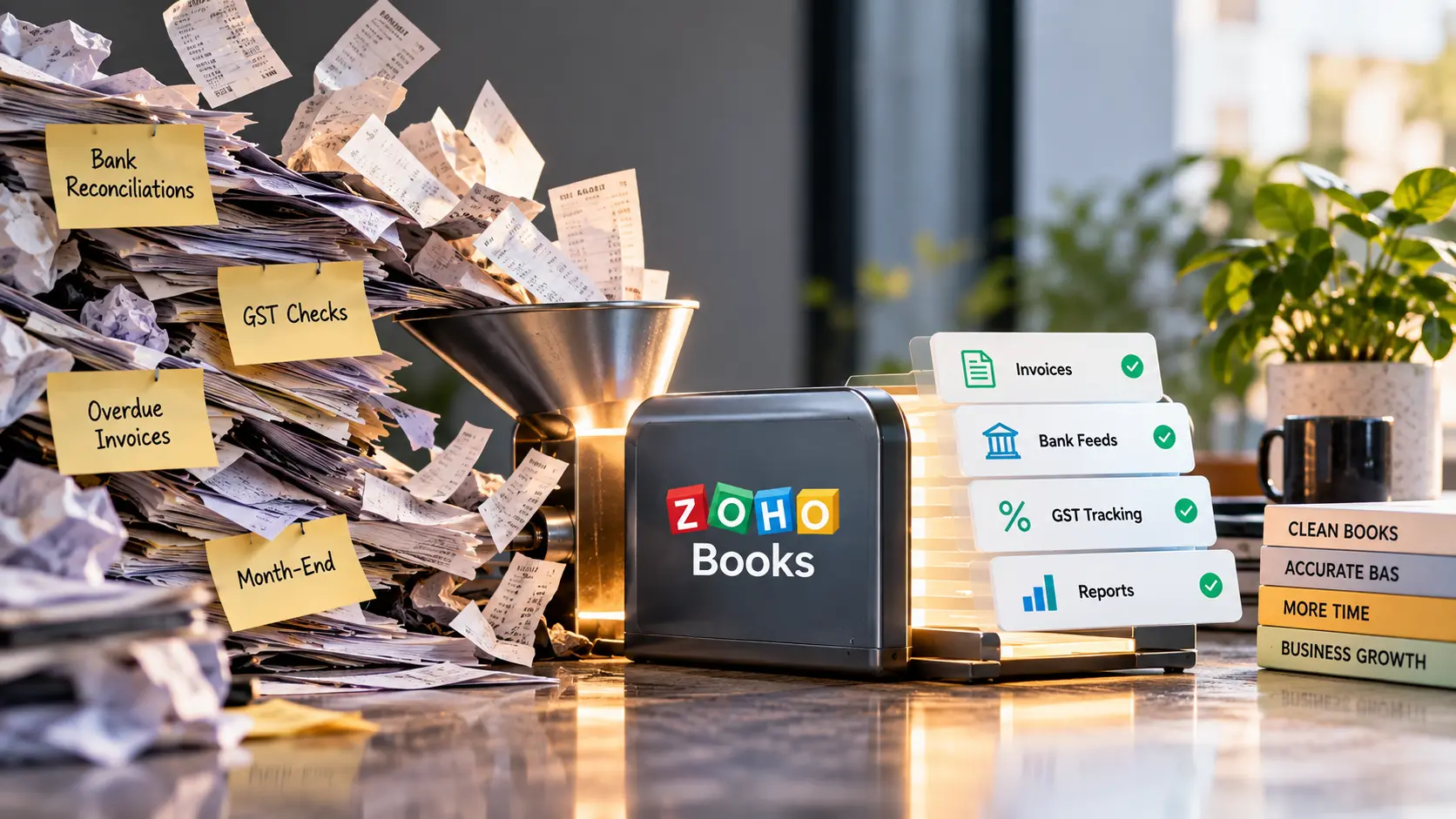
You moved to Zoho Books to save time. So why are bank transactions still being cleaned up, GST codes still being checked, overdue invoices still being chased and month-end still landing back on your desk?
The problem is usually not the software. It is expecting automation to replace review, judgement and ownership.
For Australian business owners, the real value of Zoho Books comes from knowing what to automate, what still needs checking, and what is no longer worth doing yourself.
What Should Zoho Books Be Automating for You?
If you are manually repeating the same bookkeeping steps every week, you may be underusing the automation already available inside Zoho Books.
Depending on your plan, Zoho Books supports recurring invoices and expenses, payment reminders, bank statement imports or connected feeds, bank rules, transaction matching, receipt scanning and scheduled reports.
The practical split looks like this:
| Bookkeeping Task | Let Zoho Books Handle | Still Needs Human Attention |
| Recurring invoices | Generate repeat invoices | Incorrect rates, unusual billing or disputed invoices |
| Payment reminders | Send scheduled reminders | Debtors requiring active follow-up |
| Bank transactions | Import/feed, categorise and match transactions | Unmatched, duplicated or unusual transactions |
| Receipts and expenses | Capture information and attach records | Correct coding, GST treatment and missing evidence |
| Reconciliation | Suggest matches and speed up processing | Differences that do not reconcile cleanly |
| GST / BAS data | Track GST and generate BAS reports | Checking the transactions and tax treatment underneath them |
| Reporting | Generate and schedule reports | Deciding whether the numbers are reliable enough to act on |
Zoho Books can automate a significant amount of repetitive processing. But a rule can only follow the logic it has been given.
If the task follows a repeatable rule, automate it. If it requires explanation, correction or judgement, someone still needs to own it.
Where Zoho Books Automation Still Needs Human Review
Automation removes repetition. It does not automatically fix a transaction that is wrong, incomplete or unusual.
A bank rule may correctly process dozens of transactions and still misclassify an unusual one. A receipt may be captured but coded incorrectly. An invoice can remain overdue even after automated reminders have been sent.
That is where the time expected to disappear through automation often comes back.
| When Zoho Books Shows… | Someone Still Needs To… |
| Unmatched bank transactions | Find the supporting record and determine the correct treatment |
| Reconciliation differences | Trace duplicates, omissions, timing differences or incorrect entries |
| Uncategorised expenses | Apply the appropriate account and GST treatment |
| Missing documents | Obtain the supporting evidence |
| Overdue invoices | Decide when reminders need to become active debtor follow-up |
| Unusual supplier bills | Check coding, approval and timing |
| Unexpected GST/BAS figures | Review the transactions producing the result |
| Month-end reports | Confirm key balances are reconciled before relying on them |
The Real Problem Is Exception Work
For many growing businesses, routine transactions are no longer the biggest bookkeeping burden.
It is the exceptions.
A handful of transactions requiring investigation can consume more owner time than hundreds that process cleanly.
Automation reduces the number of transactions you touch. Good bookkeeping reduces the number of problems that reach your desk.
Before relying on the numbers, someone should still be able to answer:
- Are the bank accounts reconciled?
- Are key balance-sheet accounts reasonable?
- Are overdue receivables being followed up?
- Are GST treatments appropriate?
- Are unusual movements explained?
If those questions continually return to the business owner, the bookkeeping process still depends too heavily on them.
Do I Need a Bookkeeper if I Use Zoho Books?
Not necessarily.
A business with modest transaction volumes and relatively straightforward bookkeeping may be able to manage much of the routine work using Zoho Books.
The need for support usually appears when the software is no longer the bottleneck.
Typical warning signs are:
- Reconciliations regularly fall behind
- BAS periods begin with clean-up work
- Month-end accounts are delayed
- Overdue debtors need manual intervention
- The owner is still fixing coding or chasing documents
- Reports exist, but nobody fully trusts the numbers
Zoho Books supports accountant access and user permissions, allowing an external accounting professional to work in the same organisation rather than requiring files to be passed backwards and forwards.
A Simple Test
Ask yourself:
If I stopped touching Zoho Books for two weeks, would the books still stay current and accurate?
If the answer is no, you may not need different software.
You may simply need someone to own the bookkeeping properly.
Can Zoho Books Handle BAS for Australian Businesses?
Yes. Zoho Books supports Australian GST settings and can generate BAS reports from the transactions recorded in the system. Businesses can configure their ABN, reporting period and cash or accrual basis within the Australian edition. Zoho
But there is an important distinction:
Generating BAS figures is not the same as having BAS-ready books.
Before relying on the report, someone still needs to confirm that:
- bank and credit-card accounts are reconciled
- GST has been applied appropriately
- duplicate or missing transactions are resolved
- adjustments and journals are supported
- source documents are available
- unusual GST movements make sense
Zoho’s Australian help documentation shows the BAS report being generated and reviewed inside Zoho Books, while lodgement occurs separately through the ATO process. The return can then be recorded as filed within Zoho Books.
Where SMEs Usually Get Stuck
The question is rarely:
“Can Zoho Books produce a BAS report?”
It can.
The more important question is:
“Can I trust the transactions feeding that BAS report?”
If every BAS period begins with hours of reconciliation, coding corrections and missing-document follow-up, the reporting feature is not the problem.
The bookkeeping behind it is.
When Should I Outsource My Bookkeeping?
Outsourcing starts to make sense when Zoho Books is working, but maintaining accurate books is still taking time away from running the business.
Good first tasks to hand over include:
- bank and credit-card reconciliations
- transaction coding and exception review
- accounts payable and receivable administration
- missing-document follow-up
- month-end bookkeeping
- management reporting preparation
- BAS preparation support
The goal is not to outsource the software.
It is to stop the software depending on you.
Can I Outsource Bookkeeping and Keep Using Zoho Books?
Yes.
An outsourced bookkeeper can work within your existing Zoho Books environment while you retain access to the same transactions, invoices and reports.
The important part is defining ownership.
| Business Owner / Manager | Bookkeeping Support |
| Commercial approvals | Transaction review and coding |
| Supplier and customer decisions | Bank and card reconciliations |
| Context for unusual transactions | AP/AR administration |
| Reviewing business performance | Month-end bookkeeping |
| Final tax/BAS decisions with the appropriate adviser | BAS preparation support and supporting records |
Set permissions, approval limits and review points from the beginning.
The objective is to remove routine bookkeeping from the owner without removing visibility or control.
For Australian SMEs already using Zoho Books, Accounting Gurus can work within the existing system and manage agreed bookkeeping workflows rather than forcing an unnecessary software change.
Keep the platform you know. Hand over the bookkeeping that keeps stealing your time.
Let Zoho Books Save Time Without Making You the Bookkeeper
Zoho Books can automate invoices, reminders, bank processing and recurring work.
But if you are still fixing reconciliations, checking GST, chasing debtors or cleaning the file before BAS, the software is only solving part of the problem.
The practical approach is simple:
Automate what follows a rule. Review what affects accuracy. Outsource what keeps pulling you back into the books.
Accounting Gurus can work within your existing Zoho Books setup, taking over agreed bookkeeping workflows while you keep visibility and control.
Good accounting software should give you better numbers. Good bookkeeping should give you your time back.
If Zoho Books is working but bookkeeping is still landing on your desk, the process, not the platform, is probably what needs to change.