
Your business has sent out $80,000 worth of invoices this month. But only $45,000 has reached your bank account. Meanwhile, wages, rent, supplier bills and an upcoming BAS payment still need to be covered.
Sound familiar?
For many Australian SME owners, the issue isn’t always a lack of sales. It’s the gap between earning money and actually receiving it.
A 13-week cash-flow forecast helps you plan for that gap. It shows how much cash you expect to have each week, when major payments are coming up and whether you have enough money to cover them.
You can build one in Excel using financial records you already have.
This guide walks you through the process, with an example and a free spreadsheet you can adapt for your business.
What you’ll get from this guide:
A practical method for preparing your next 13 weeks of cash movements.
A worked example showing how to spot a cash shortage.
An Excel template with automatic calculations and a weekly review sheet.
What Is a 13-Week Cash-Flow Forecast?
A 13-week cash-flow forecast estimates the money coming into and leaving your business each week over approximately three months.
Rather than focusing on revenue or accounting profit, it tracks expected cash movements. This is commonly called direct cash-flow forecasting.
The calculation is straightforward:
Opening cash + Cash received – Cash paid = Closing cash
That closing balance becomes the opening balance for the following week.
Here’s a simple example.
Your business starts Monday with $42,000. You expect to collect $34,000 from customers and pay $31,000 in expenses during the week.
Your forecast closing cash is $45,000.
Repeat this for 13 weeks, using the payment dates you expect rather than simply dividing a monthly budget into equal amounts.
The forecast becomes a 13-week rolling forecast when you update it each week. Once a week finishes, you record what actually happened and add another week at the end.
Why use 13 weeks instead of a monthly forecast?
A monthly business cash flow forecast is useful for planning, but it can hide a shortage that occurs halfway through the month.
Suppose your business expects to finish November with $35,000 in the bank. That sounds comfortable.
But what if a $20,000 BAS payment and a $15,000 supplier payment both fall due before your biggest customer settles their invoice?
You could have a problem for several days, even though the month-end figures look fine.
A weekly forecast makes those timing differences easier to see.
What Do You Need Before Building the Forecast?
You don’t need complicated software. Excel or Google Sheets will do.
You do need financial information that is current enough to rely on.
Start with these four things:
1. Your latest reconciled bank balances. Check what money is actually available, including any payments that haven’t cleared or funds that can’t be used.
2. An aged receivables report. This shows which customers owe you money, how much they owe and how long invoices have been outstanding.
3. An accounts payable report. Use this to identify supplier bills, payment amounts and expected payment dates.
4. A schedule of other commitments. Include payroll, superannuation, rent, loans, tax payments and planned one-off purchases.
If your bookkeeping is behind, correct the important balances and outstanding transactions before treating the forecast as reliable.
Otherwise, you’ll be making decisions using figures that may already be wrong.
How to Build Your 13-Week Cash-Flow Forecast
Step 1: Start With the Cash Available Today
Use your reconciled available bank balance as the opening amount for Week 1.
If your accounts show $55,000 but $13,000 is restricted and unavailable for operating payments, your usable starting balance may be only $42,000.
Make sure you’re not counting money twice. Moving funds between two of your own business bank accounts does not create additional cash.
Enter your starting balance in the first week of the spreadsheet.
Step 2: Estimate When Customers Will Actually Pay
This is where many forecasts start to go wrong.
An invoice due next Friday isn’t necessarily money you’ll receive next Friday.
Look at how customers have paid in the past.
For example, a customer owes you $12,000 with payment due in Week 2. But they usually pay two weeks late.
Unless they’ve confirmed an earlier payment, Week 4 is probably a more sensible estimate.
Go through your largest outstanding invoices first. Check overdue amounts, payment arrangements and any disputes.
Keep confirmed customer payments separate from sales you’re still hoping to make.
And if you regularly have overdue invoices, improving your accounts receivable management can make your cash forecasts more dependable.
Step 3: Schedule Your Payments in the Correct Weeks
Now list the cash your business expects to pay out.
Include regular expenses such as supplier bills, rent and utilities, along with payroll, loan repayments and planned purchases.
Then check payments that don’t necessarily happen every week.
For Australian SMEs, these may include BAS liabilities, GST, PAYG withholding and PAYG instalments, depending on the business’s reporting obligations.
Use the dates shown in your ATO records rather than assuming all businesses follow the same payment schedule.
Don’t forget Payday Super.
Since 1 July 2026, employers have generally been required to pay super guarantee contributions each payday. Contributions must ordinarily reach the employee’s super fund within seven business days, although exceptions apply.
That means your forecast needs to reflect superannuation payments alongside your actual payroll cycle, not automatically treat them as quarterly expenses.
Also check how you’ve recorded GST and PAYG. If you’re entering GST-inclusive customer receipts and supplier payments, make sure you record the actual BAS amount due without counting the same cash movement twice.
Your aim is to show the money that will leave your bank account and when it will leave.
Step 4: Calculate the Closing Balance for Every Week
Once you’ve entered the receipts and payments, the spreadsheet can calculate each week’s net cash movement and closing balance.
For example:
Week 1
Opening cash: $42,000
Expected receipts: $34,000
Expected payments: $31,000
Closing cash: $45,000
Week 2 then starts with that $45,000 balance.
Continue through all 13 weeks, making sure the closing balance of one week feeds into the opening balance of the next.
Our Excel template does these calculations automatically.
Step 5: Set a Minimum Cash Buffer
Your forecast might stay positive for all 13 weeks, but that doesn’t necessarily mean everything is comfortable.
A business with $8,000 left in the bank may still struggle if another payroll run is about to fall due.
Choose a minimum cash buffer based on your expenses, upcoming commitments and uncertainty around customer payments.
For our example, we’ll use $20,000.
This is an illustrative management target, not a required amount for every SME.
Now compare your forecast closing balance against that buffer for each week.
Any week below the buffer deserves closer attention.
What Does a 13-Week Cash-Flow Forecast Actually Show?
Let’s use an Australian SME that starts with $42,000 in available cash and sets a $20,000 minimum buffer.
The business expects customer payments throughout the quarter. Its outgoing payments include suppliers, wages, superannuation, rent and an upcoming BAS obligation.
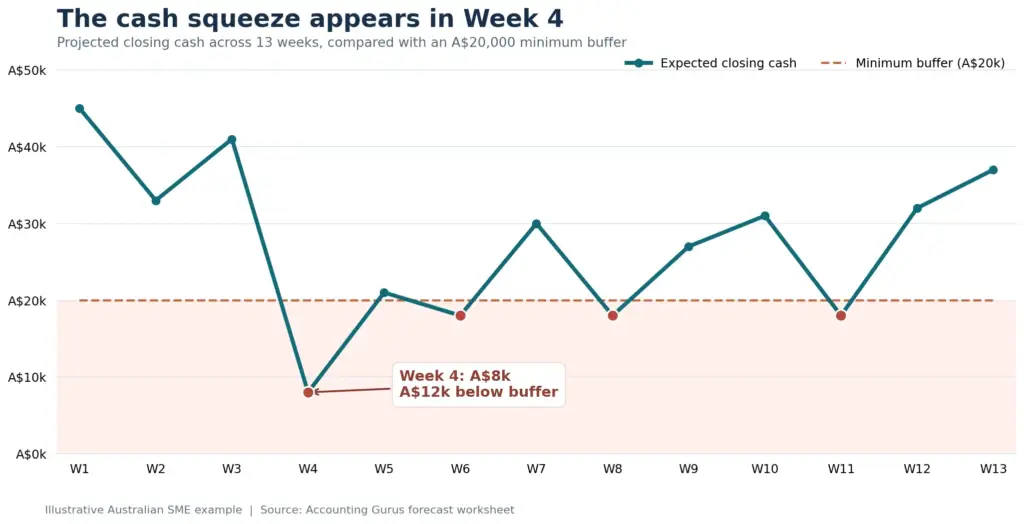
Chart: Illustrative weekly closing cash balances compared with a $20,000 minimum cash buffer.
Look at Week 4.
The business starts that week with $41,000 and expects to receive $24,000 from customers. But its scheduled payments total $57,000.
That leaves just $8,000 in closing cash, which is $12,000 below the chosen buffer.
The chart also shows balances below the buffer in Weeks 6, 8 and 11.
Yet by Week 13, the business expects to have $37,000.
If the owner only looked at the final balance, they might never notice those tighter weeks.
The next step is to investigate the problem weeks.
Could a major overdue invoice be collected earlier? Is a planned equipment purchase essential right now? Are the dates for the largest payments correct?
The forecast doesn’t make these decisions for you. It shows which decisions need attention.
One more thing: even a positive weekly closing balance can hide a shortage during the week. If wages are due on Tuesday but customer receipts aren’t expected until Thursday, check those daily payment dates separately.
What Happens When the Forecast Is Wrong?
No forecast gets every payment date right.
The important part is finding out why the figures changed and correcting your next estimate.
Return to Week 4 in our example.
The business expected $24,000 in customer receipts, but only $16,000 arrived. A customer delayed an $8,000 payment.
At the same time, actual payments were $54,000 rather than the expected $57,000 because an agreed $3,000 supplier payment moved to the following week.
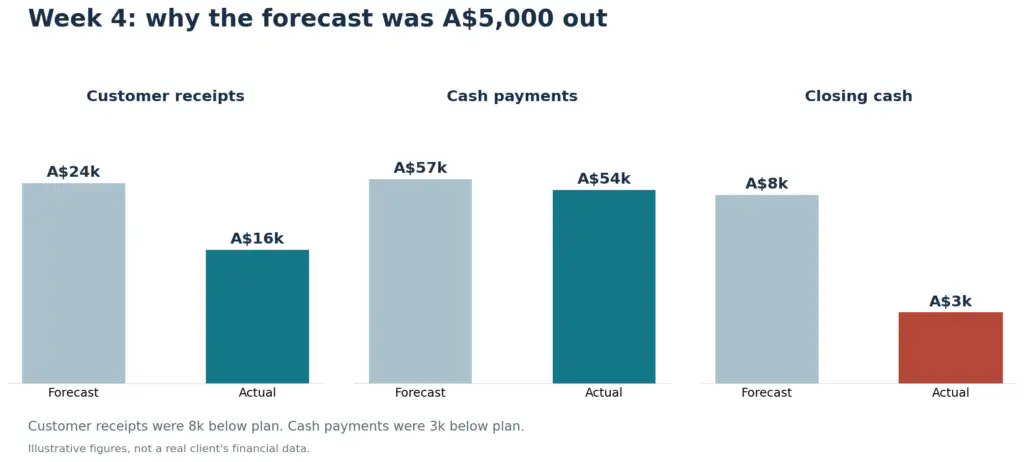
Chart: Expected and actual receipts, payments and closing cash for Week 4.
The result?
Expected closing cash was $8,000. Actual closing cash was only $3,000.
That’s a $5,000 difference.
Now the owner needs to establish two things:
- When is the delayed $8,000 customer payment realistically expected?
- Which week will the $3,000 supplier payment now leave the bank?
Both amounts must be moved into the updated forecast.
Otherwise, the next few weeks will appear healthier than they really are.
This comparison is called forecast-versus-actual analysis. It is one of the most useful ways to improve cash flow forecasting over time.
A Practical Weekly Routine to Keep Your Forecast Reliable
You don’t need to rebuild your spreadsheet from scratch every Monday.
Use the same routine each week.
Your weekly cash-flow check:
- Reconcile the previous week’s bank transactions.
- Compare actual receipts and payments with the original forecast.
- Investigate significant differences, particularly delayed customer receipts.
- Update expected payment dates, then add a new Week 13.
- Check which weeks fall below your minimum cash buffer and decide what needs attention.
Keep a copy of the original forecast figures before making changes. Otherwise, you’ll lose the comparison that tells you whether your earlier assumptions were accurate.
It’s also worth testing one or two realistic scenarios.
For example, what would happen if your largest customer paid two weeks later than expected? Or if a major supplier payment and payroll fell in the same week?
You don’t need to create dozens of scenarios. Start with the changes that could have the biggest effect on your available cash.
The goal is to understand how much room your business has if things don’t happen exactly as planned.
Three Mistakes That Can Make Your Forecast Unreliable
Assuming every customer will pay on time
Use actual collection history and follow up overdue invoices. A forecast built entirely around invoice due dates is often too optimistic.
Leaving out irregular payments
Insurance renewals, tax obligations, equipment purchases and other large payments can change your cash position significantly. Check the full 13-week period for anything outside your normal weekly expenses.
Updating the spreadsheet without fixing the underlying records
If bank reconciliations are incomplete or customer balances are incorrect, changing the forecast won’t solve the underlying issue.
Good forecasting depends on having reasonably accurate financial records in the first place.
When Does an SME Need Help With Cash-Flow Forecasting?
A small business with straightforward finances might manage its forecast with a spreadsheet and a weekly review.
But it becomes more difficult when you’re handling multiple bank accounts, high invoice volumes, overdue customers, larger payrolls and regular reporting commitments.
Often, the difficult part isn’t calculating the closing balance. It’s making sure the information going into that calculation is accurate.
Your bookkeeping needs to be current. Customer and supplier balances need to be checked. Payroll and tax commitments need to be recorded in the correct periods.
That’s where ongoing accounting and finance support can help.
At Accounting Gurus, we provide dedicated offshore accounting and finance professionals who support Australian businesses with bookkeeping, reconciliations, receivables, payables and financial reporting.
Our Outsourced Finance Department offers a broader way to manage ongoing finance processes and reporting requirements, with support arranged around your business’s needs.
Frequently Asked Questions
Can I prepare a 13-week cash-flow forecast in Excel?
Yes. Excel is a practical starting point for many SMEs. You need weekly opening balances, expected receipts, outgoing payments and formulas to calculate closing cash. You can use our free template to get started.
How often should I update the forecast?
At least weekly is a sensible starting point for a rolling 13-week forecast. If cash is tight or several large payments are approaching, check the relevant days more frequently.
What should I do if my forecast shows a cash shortage?
First check that your bank balance and payment assumptions are correct. Then look at expected customer collections, discretionary spending and any available funding arrangements. Get advice early if you anticipate difficulty meeting wages, tax, superannuation or other payment obligations.
Start With Your Next 13 Weeks
You don’t need a complicated financial model to get a clearer picture of your business’s cash position.
Start with your bank balance, list the money you realistically expect to receive, and enter the payments you know are coming.
Then review the figures each week.
You’ll be in a better position to spot tight weeks, investigate delayed payments and make decisions before a cash shortage catches you by surprise.
Ready to Build Your Own 13-Week Forecast?
Use our free Excel template to plan expected cash receipts and payments, identify shortfalls and review your cash position each week.
Need help keeping your accounts and finance reporting up to date?
Talk to Accounting Gurus about dedicated accounting and finance support for your business.