
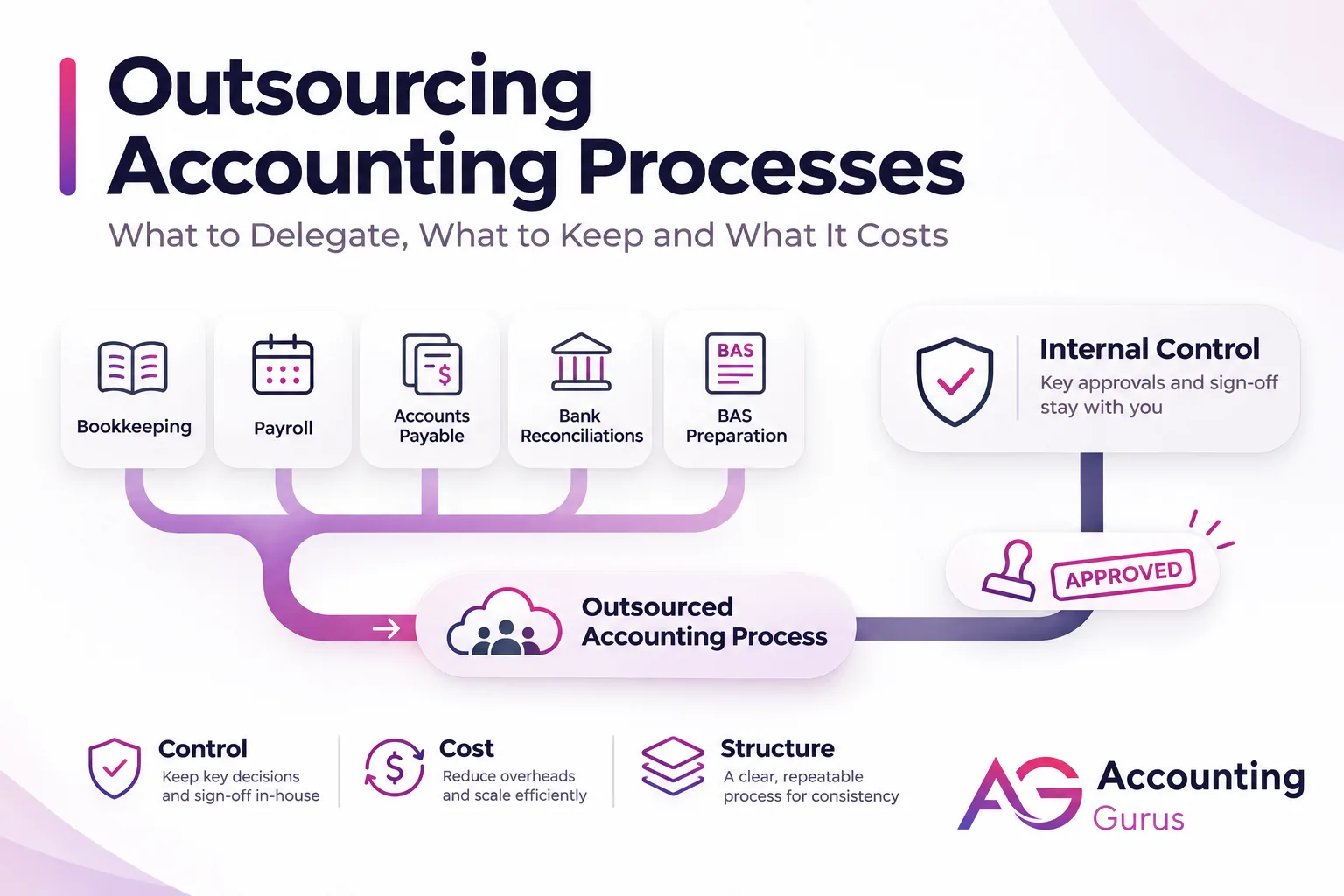
Outsourcing Accounting Processes means handing repeatable finance tasks to an outside provider. Bookkeeping, payroll and BAS preparation are typical examples. The business keeps final decisions and sign-off.
Why does a capable team still run late every month-end? Many finance teams are not short of skill. They are short of hours for the routine work that piles up each cycle.
Australian SMEs and startups suit outsourcing when transaction volume outgrows the team. Accounting firms with busy peaks, and payroll processing businesses facing heavy pay weeks, can benefit too. You will see which model fits, what it costs, and how to hand over records safely. Ask whether the work is the bottleneck or the decisions are, because only repeatable work moves easily to an outside team.
Key Takeaways
- Outsourcing moves repeatable finance work to a provider, not final decisions.
- Startups, SMEs and accounting firms with peak workloads gain the most.
- Confirm the engagement model before you sign anything.
- Start with one task that repeats on a fixed calendar.
- Hand over records at a clean month-end cut-off.
- Keep one internal owner for each month’s sign-off.
What Outsourcing Accounting Processes Covers
Outsourced accounting means a business pays an external provider to run finance tasks its own staff would otherwise do. A two-person bookkeeping team that falls a month behind every quarter is often the first sign. Some of that work can be handed over.
Outsourcing Accounting Processes uses one of five engagement models, and the model sets who owns the result. The common options are:
- Freelance: one person completes one job, such as a single tax return.
- Project-style work: the provider runs a defined project to a written specification.
- Business process outsourcing: the provider recruits, equips and manages a dedicated team.
- Build-operate-transfer: the provider sets up the team, runs it, then hands it over to the business.
- Co-sourcing: a model where the business keeps some finance tasks in-house while an external provider handles the rest.
A managed monthly service is the usual choice for recurring work. The service provider typically covers bookkeeping, bank reconciliations and the month-end close. Project-style work suits a one-off clean-up or a system migration.
A freelancer cannot own a recurring month-end close. Business activity statements (BAS) must reach the Australian Taxation Office on time, so the provider needs the lodgement dates from day one. A managed team usually tracks those dates as part of its monthly routine. Confirm which model the provider uses before signing, because a freelancer and a managed team carry different responsibility for the month-end close.
Outsourcing Compared With Hiring In-House
Finance outsourcing usually costs less than a full-time hire when finance work arrives in peaks rather than every week. The comparison turns on three factors: the full cost of a hire, how the work comes in, and who controls daily priorities. Each factor can tip the choice either way.
Salary, Super and Onboarding Costs
A full-time accounts officer costs more than the salary once superannuation and onboarding are counted. The superannuation guarantee rate increased to 12 per cent on 1 July 2025. Under the Payday Super rules introduced on 1 July 2026, employers calculate super on qualifying earnings and generally must ensure contributions reach employees’ super funds within seven business days after payday.
Recruitment, training and leave cover add to the bill. The role also stays empty while the business searches, so the work either slips or someone else absorbs it.
Scaling Up for BAS and Year-End Peaks
Take a business where BAS and payroll work spikes in the last two weeks of each quarter. The rest of the month is quiet. A full-time hire sits idle for much of that time, yet the salary runs every week.
A provider can scale the team up for the peak and back down for the quiet weeks. The business pays for the hours the work needs. That gap is the main reason outsourcing often costs less for peak-driven accounting work.
Control Over Daily Decisions
An in-house person can be redirected each day, which gives the business fast control over priorities. An outside team works to agreed deadlines and a written scope instead. Changes need a formal request, which slows down sudden switches.
A business with steady daily volume and frequent judgement calls may still need an in-house person. Compare both options over twelve months of real workload, including the quiet weeks, because an idle hire is the cost most often missed.
Which Accounting Processes Suit Outsourcing First
Tasks that repeat on a fixed calendar and have clear right answers suit outsourcing first. Bank reconciliations and accounts payable are the usual starting points. Tasks that need judgement stay with the internal team.
Employers report pay and super to the Australian Taxation Office through Single Touch Payroll each time staff are paid. BAS are lodged quarterly, and bank reconciliations are done for each account every month. Accounting business services cover the back-office work a firm does not need to hold in-house, such as bookkeeping, reconciliations and month-end close.
| Task | How often it recurs | Outsource first? | Keep in-house |
| Bank reconciliations | Monthly for each account | Yes | Review of unusual items |
| Accounts payable | Weekly bill runs | Yes | Approval of large payments |
| Accounts receivable | Weekly collections | Yes, for invoicing and follow-up | Credit decisions and disputes |
| Payroll runs | Each pay run | Yes | Pay rate changes and approvals |
| BAS preparation | Quarterly | Yes, for preparation | Lodgement sign-off |
| Management reporting | Monthly | Partly | Strategic interpretation |
Handing over pay rate changes is a common error. The business still needs to approve those changes itself. A business with a complex project ledger may keep reconciliations in-house at first, until the data is clean. Move one task for two cycles before adding the next, so errors show up while the scope is still small.
Checking a Provider’s Experience and Systems
A provider should prove it can meet the agreed scope before you sign. Ask the provider to run one month of your bank feed through a trial file. Accounting outsourcing services in Australia vary in staffing, supervision and reporting, so the trial shows what you will actually receive.
Accounting Software the Team Must Use
Cloud platforms Xero, MYOB and QuickBooks are the common ones among Australian small businesses. The provider should work inside your own software rather than move your records into a new system. It should also ask for limited access first and widen it only when the work is proven.
Ask for a sample monthly report and check whether it matches your chart of accounts. Requirements for reporting should be written into the scope before the first month starts.
Track Record, Credentials and Registration
A registered tax agent appears on the public register kept by the Tax Practitioners Board. Check the name there before you share any login details. Members of CPA Australia and Chartered Accountants Australia and New Zealand hold recognised accounting qualifications.
A sole practitioner with full credentials may still be too small to cover a deadline calendar. Ask about backup staff for peak weeks. Accounting outsourcing companies in Australia differ in how they supervise staff, so ask how each one is supervised. Ask who signs off each lodgement, since that name is the person who checks the work.
Running the Handover Without Losing Records
Pick a month-end as the handover date, and only after that month’s bank accounts are reconciled. Australian businesses generally must retain relevant tax and business records for at least five years, although some records must be kept longer. A clean cut-off gives the provider known balances and a clear list of open items to start from.
The handover follows five steps:
- Set a month-end cut-off.
- Reconcile each bank account and note the reconciliation date.
- List open items such as unpresented payments, unallocated receipts and missing invoices.
- Agree the document channel and one contact person for queries.
- Archive the old file so it stays available for the five-year retention period.
Starting the new provider mid-month is the most common mistake. The balances then cannot be checked against a closed period. If the previous adviser is finishing the month in progress, the handover can split by accounting period instead. Export a full copy of the old ledger before the first day of the new process, since old systems often close access early.
What Outsourced Accounting Costs in Australia
The cost of outsourced bookkeeping depends on business size, monthly transaction volume and the complexity of the work involved. Smaller businesses with straightforward records may require fewer hours, while growing businesses often need more frequent processing, reconciliations and reporting.
The following table provides illustrative monthly budgeting ranges based on business size and transaction volume. These are planning examples, not verified Australian market averages or Accounting Gurus quotations.
| Business size | Transactions per month | Illustrative monthly budget |
|---|---|---|
| Micro business | Fewer than 50 | $300–$600 |
| Small business | 50–150 | $600–$1,200 |
| Medium business | 150–400 | $1,200–$2,500 |
| Larger SME | More than 400 | $2,500–$5,000 |
Actual costs can fall outside these ranges. For context, Xero’s Australian bookkeeping guide reports general outsourced bookkeeping fees of approximately $500–$2,500 per month, depending on business size and requirements.
Transaction volume, bank accounts, payroll headcount, currencies and additional reporting requirements can all influence the final fee.
Some providers charge hourly, while others use fixed monthly packages or dedicated resource arrangements. The number of transactions alone does not determine the cost, particularly when payroll, BAS preparation or complex financial reporting is involved.
Ask each provider for a written quotation showing the monthly fee, included work and circumstances that trigger additional charges. Confirm whether prices include GST.
The most useful comparison is the total cost of managing your business’s actual accounting workload, rather than the hourly rate alone.
Offshore, Onshore and Hybrid Teams
An onshore team gives same-day answers and local tax knowledge, an offshore team costs less per hour, and a hybrid setup sits between them. Manila is two hours behind Sydney during standard time and three hours behind during daylight saving. Response times depend on the offshore team’s agreed working hours and communication arrangements.
Offshore Teams and Time Zones
Offshore teams overlap with the business day only in part. They often cost less per hour than onshore staff. They also need training in Australian tax rules before they touch client work.
Assuming an offshore team knows state payroll tax rules without training is a costly error. The company should test the team on those rules during the trial period.
Onshore Teams and Australian Tax Knowledge
Onshore teams give same-day answers and local tax knowledge at a higher rate. They suit a business that needs quick decisions on tax positions. A firm that needs same-day answers during the BAS week should lean onshore.
Hybrid Setups With Local Oversight
A hybrid setup places a local supervisor who reviews the offshore work before it reaches the business. This keeps the lower hourly cost and adds a checkpoint that an Australian reviewer controls. Your deadline pattern decides which setup fits, since a BAS week needs a same-day answer. Agree in writing which hours the team covers and the response time for a query, because the time difference sets how fast a fix can happen.
Protecting Financial Data When Work Leaves the Office
Before overseas staff log in, the business must take reasonable steps to confirm the provider will meet the Australian Privacy Principles. The business stays accountable for what the overseas recipient does with the information. Financial data needs the same protection wherever the work is done.
The Australian Cyber Security Centre’s Essential Eight is a baseline of mitigation strategies. Multi-factor authentication adds two or more identity-verification factors to account access. The table below lists the controls to ask about.
| Control | What it protects against | Check to ask the provider |
| Multi-factor authentication | Stolen passwords | Is it on for every login, with two or more factors? |
| Least-privilege access | Staff seeing payroll or bank data they do not need | Which roles see payroll and bank logins? |
| Encrypted storage and devices | Lost laptops and public Wi-Fi | Is data encrypted on devices and in transit? |
| Data location and offshore disclosure | Breach of APP 8 duties | Where is data stored, and has the business been told about offshore access? |
| Records retention and deletion | Data kept longer than needed | How long are copies kept, and how is deletion confirmed? |
| Confidentiality agreements | Staff misuse of client data | Does every staff member sign written confidentiality terms? |
Accepting a provider’s security statement without evidence that multi-factor authentication is switched on is a common mistake. Ask for a screenshot of the setting or a written confirmation. A fully onshore team still needs multi-factor authentication and access controls. Ask for the access list every quarter, since staff rotate and old logins are a common gap.
Keeping Control of Quality and Decisions
Deloitte’s 2024 Global Outsourcing Survey found that 70 per cent of surveyed executives had selectively brought previously outsourced activities back in-house over the preceding five years. The business keeps control by naming one internal owner who reviews each month’s close. The owner checks the outsourced work before it becomes the official record.
Nobody reviews a close that has no named owner.
The internal team runs five checks each month:
- Bank reconciliations signed off by an internal owner.
- Payroll variance review against the last pay run.
- Aged receivables and payables list reviewed each month.
- Management report compared with last month and with budget.
- Check that all payments above an approval threshold were approved internally.
A small business may review only the monthly report and the sign-off. A business with a larger workload should run all five checks, because each one catches a different type of error. The efficiency gained from outsourcing depends on these checks staying in place. Name one internal owner who signs each month’s close, since unclear sign-off is what most often drives work back in-house.
Conclusion
Start with one repeatable task, a month-end cut-off and a named internal owner for sign-off. Those three steps give the team a clear starting point and a way to check the work. Keep final approval and pay rate decisions inside the team, because the provider handles the routine tasks, not the choices that carry the risk.
Next, list your monthly transactions, your payroll headcount and the three tasks that cause the most delay this quarter. Choose one of those tasks for a two-month trial with a provider. Set the date of the trial review now, so the first two months are judged on measured results rather than feel.
Need More Accounting Capacity Without Expanding Your In-House Team?
Whether you’re an Australian accounting firm managing seasonal workloads or a growing business struggling to keep up with finance tasks, Accounting Gurus helps you build additional accounting capacity through experienced offshore professionals.
From bookkeeping and payroll processing to reconciliations and financial reporting support, our team works within your existing systems and workflows, backed by Australian-based project management.
Choose from flexible block hours, part-time or full-time dedicated resources, depending on your workload and business requirements.
Explore Our Accounting Outsourcing Services to find the right support for your team.
FAQ
What is outsourcing in accounting?
Outsourcing in accounting means a business hands recurring finance tasks to an external provider. The provider works like an in-house team and handles bookkeeping, payroll, accounts payable and BAS preparation. The business keeps final decisions and sign-off, and it still owns the results. Most engagements run on a monthly fee tied to a scope agreed in writing.
What are the four types of outsourcing?
The four common types are freelance work, project-style work, business process outsourcing and build-operate-transfer. Freelance covers one job done by one person. Project-style work delivers a defined project to a written specification. Co-sourcing, where the business keeps some tasks in-house, is a fifth option that many firms choose.
What is the number one reason for outsourcing?
Cost was the main reason for outsourcing in the past, but improving business performance is now a top driver. A shortage of capacity is the usual trigger, such as a team that falls behind at month-end or in payroll weeks. Outsourcing lets a business add skilled hours in peaks without a full-time hire. Compare the full cost of a hire before deciding.
What are 10 examples of outsourcing?
Ten common examples are bookkeeping, payroll, accounts payable, accounts receivable, bank reconciliations, month-end close, BAS preparation, financial statements, management reporting, and budgeting and forecasting. Bank reconciliations and accounts payable are usually the easiest to hand over first. Each one repeats on a fixed calendar, so an outside team can follow a clear routine.
What is the top 1 outsourcing country?
According to Ataraxis Management’s 2026 Global Outsourcing Talent Index, the Philippines ranks first among 193 countries, followed by Malaysia and India. The index evaluates labour costs, language proficiency, talent availability, infrastructure and stability. It is one provider’s benchmarking model, not a universal ranking for every accounting role. The best outsourcing location still depends on the required skills, supervision and service arrangements.
What is the most common type of outsourcing?
Recurring managed services for bookkeeping and payroll are the most common type of outsourcing in accounting. They run every month and cover the routine work the business needs each cycle. Project-style work suits one-off clean-ups, year-end catch-ups and system migrations. Choose the type by asking whether the work repeats or happens once.
Disclaimer: The pricing ranges in this article are illustrative estimates, not guaranteed Australian market rates or Accounting Gurus quotations. Actual costs depend on workload, service scope and provider arrangements. Tax, payroll and compliance information is general in nature and should be verified against current Australian regulations or with an appropriately qualified professional.